
Dental Instruments
Upper 3rd Molar Forceps and Upper Extraction Forceps: Which Pattern for Which Tooth?
Oct
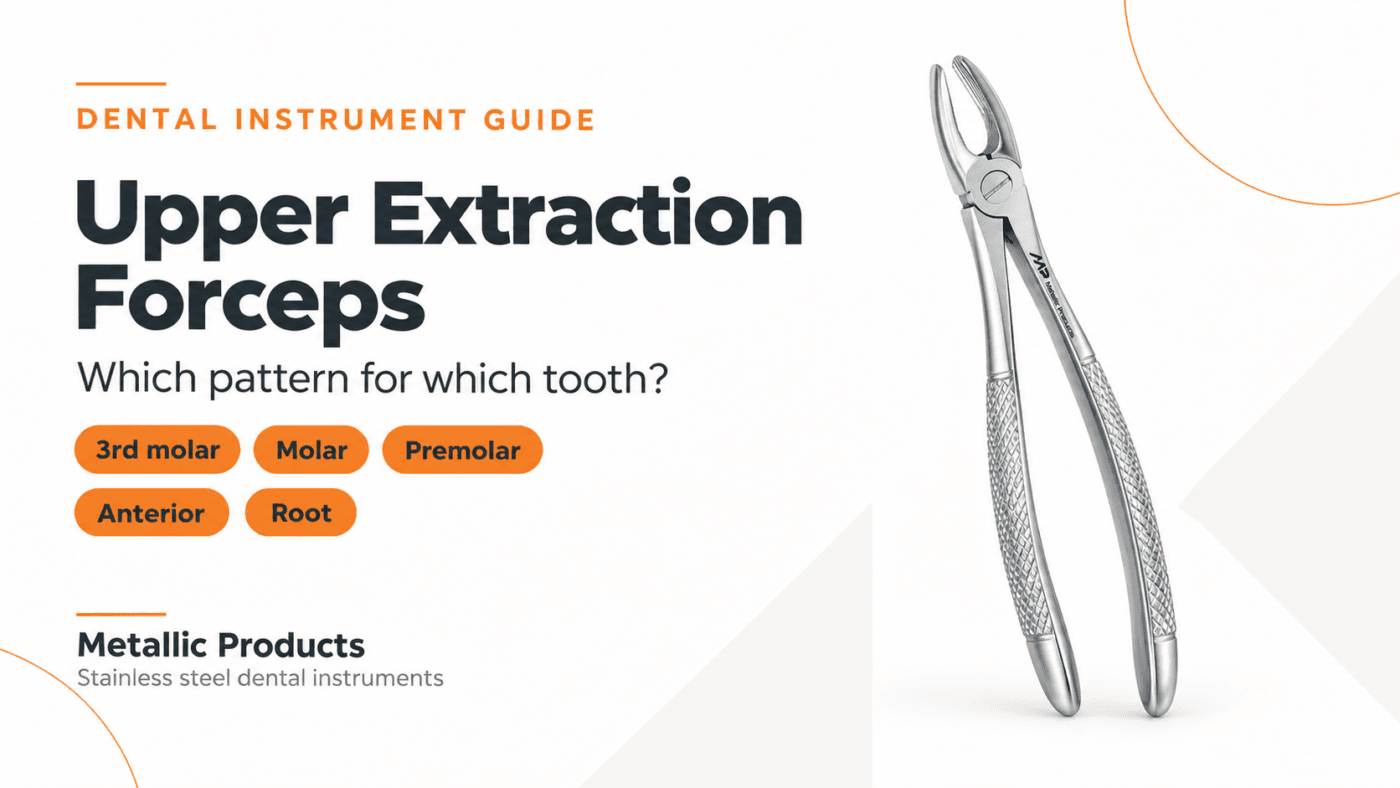
The right upper 3rd molar forceps (also written upper third molar forceps) lets you deliver a maxillary wisdom tooth with controlled, even force instead of fighting the angle of the arch. The same logic applies to every tooth in the upper jaw: the beaks, handle angle and size of an extraction forceps are built around one tooth type, and using the wrong pattern is a common cause of crown fractures and slipped grips.
This guide covers each upper pattern in turn, from third molars and molars to premolars, anterior teeth and retained roots. It explains what separates a well-made stainless steel instrument from a poor one, and links to the matching forceps in the Metallic Products English extracting forceps range.
In this guide
- Quick answer
- Why upper forceps differ from lower forceps
- Upper third molar forceps
- Upper molar forceps right and left
- Upper premolar forceps
- Upper anterior forceps
- Upper root forceps
- Steel quality and finish
- Buying from Metallic Products
- Frequently asked questions
Quick answer
Match the forceps to the tooth first, then to the side of the mouth. The table below uses English pattern figure numbers, which are the ones Metallic Products lists.
| Tooth | Upper forceps | English pattern | Shop |
|---|---|---|---|
| Central and lateral incisors | Upper incisor / anterior forceps | Fig 1, Fig 2, Fig 29 | Extracting Forceps Fig 1 |
| Canines | Upper canine forceps | Fig 1, Fig 2 | Extracting Forceps Fig 2 |
| Premolars | Upper premolar forceps | Fig 7 | Extracting Forceps Fig 7 |
| Right molars | Upper right molar forceps | Fig 17 | Extracting Forceps Fig 17 |
| Left molars | Upper left molar forceps | Fig 18 | Extracting Forceps Fig 18 |
| Third molars | Upper third molar forceps | Fig 67 / 67A | Extracting Forceps Fig 67 |
| Retained roots | Upper root forceps | Fig 51 | Extracting Forceps Fig 51 |
| Primary (baby) teeth | Child upper forceps | Fig 1S to 4S | Child Extracting Forceps |
Why upper forceps differ from lower forceps
Extraction forceps are shaped around the anatomy of the tooth they hold, so upper and lower patterns are not interchangeable. That is why catalogues keep upper and lower dental forceps in separate groups.
Maxillary bone is thinner and more porous than the mandible, and most upper teeth come out with buccal expansion supported from the palatal side. Dental upper forceps therefore have handles that sit roughly in line with the beaks, so the instrument follows the arch. Lower forceps have handles set at a sharper angle to the beaks. Upper beaks are also shaped to grip the buccal and palatal surfaces, whereas lower patterns are built around the thick lingual and buccal plates of the mandible.
Two things to confirm before you reach for any upper forceps: which tooth you are removing, and which side of the mouth it is on.
Upper third molar forceps
The upper third molar forceps is the dedicated pattern for the last tooth in the arch. You will also see it sold as upper wisdom teeth forceps, upper wisdom forceps, forceps for upper third molar or simply upper 8 forceps, after the FDI tooth number. In English pattern sets it is the No. 67.
Why a dedicated pattern matters:
- Access. The third molar sits furthest back, and a standard molar forceps often cannot seat without the handles catching on the lip or opposing teeth.
- Root form. Upper wisdom teeth usually have fused, conical or curved roots and a short crown. Beaks designed for them grip high on the crown and root junction instead of slipping off.
- One pattern, both sides. Unlike molar forceps, the upper wisdom pattern is not made in a right and left pair, so a single instrument covers both sides of the mouth.
Metallic Products lists the English pattern 67 upper third molar forceps and the 67A upper third molar forceps, both in stainless steel.
A fully erupted upper third molar can often be delivered with gentle buccal pressure and slow rocking. Avoid heavy apical force, because the maxillary tuberosity behind the tooth can fracture. Impacted or partially erupted wisdom teeth normally need an elevator first, then the forceps to complete delivery. Browse the dental elevators to build the full set.
Upper molar forceps right and left
Upper first and second molars have three roots (two buccal and one palatal), and upper molar forceps are shaped to match. For that reason they come as a pair, searched as upper molar forceps right and left, upper molar forceps left and right or upper right and left molar forceps, and also as molar forceps upper, forceps upper molar and forceps of upper molar.
One beak has a pointed tip that seats into the bifurcation between the two buccal roots. The other is smooth and rounded, and sits against the palatal root. Because the pointed tip must land on the buccal side, a right forceps will not seat correctly on a left molar. Confirm the side before you start.
Upper right molar forceps
The right upper molar forceps (also upper right molar forceps, upper molar forceps right or upper right forceps) is the English pattern No. 17. Metallic Products lists the Fig 17 upper right molar forceps, with gold-plated handle options as well as the standard finish.
Upper left molar forceps
The left upper molar forceps (also upper left molar forceps, upper molar forceps left or upper left forceps) is the mirror image, the English pattern No. 18. See the Fig 18 upper molar forceps. The listing for the plain upper left molar forceps #18 was out of stock when this article was drafted, so check availability before ordering.
American patterns use different numbers (53R and 53L are the usual upper molar pair), so always check the pattern drawing, not just the number, when you move between suppliers.
Upper cowhorn forceps
The upper cowhorn forceps, also called upper molars cowhorn forceps, has beaks that curve like a cow’s horn. It suits broken-down, heavily restored or wide-spread upper molars where there is not enough crown to grip. The sharp beak tips slide into the root bifurcation, and a squeezing action wedges the tooth upwards and out. If you searched for just upper cowhorn, this is the instrument you want.
Cowhorn designs are made in a left and right pair, which is why you will see upper right cowhorn forceps, upper left cowhorn forceps and cowhorn forceps upper. They are powerful, so keep the pressure controlled. Too much force can fracture the buccal plate or the tuberosity, and upper molars lie close to the sinus floor. Metallic Products carries the Fig 87 cowhorn forceps for lower molars. For upper cowhorn pairs, contact the team to ask about availability.
Upper premolar forceps
Upper premolar forceps are among the most searched instruments in the upper set, and the names vary: upper pre molar forceps, premolar forceps upper, premolar upper forceps, forceps for upper premolar, forceps upper premolar and forceps of upper premolar all describe the same job. If you searched for upper pre molar on its own, this is the instrument group you need.
Maxillary premolars are small and prone to root fracture. The first premolar often has two thin roots, a buccal and a palatal, so technique favours gentle buccal and palatal expansion with little or no rotation. Heavy twisting on an upper first premolar is a classic cause of a fractured root.
The dedicated English pattern is the No. 7. See the Fig 7 upper premolar forceps or the precision #7 upper premolar tool, which is also offered with a gold-plated handle.
Side-specific searches such as upper left premolar forceps and upper right premolar forceps usually point to the same instrument, because premolar forceps are not normally made as a right and left pair. Many clinicians also keep an upper universal forceps (sold as universal upper forceps), such as the American No. 150 pattern, for premolars and general upper work.
Upper deciduous molar forceps
The upper deciduous molar forceps is a smaller, lighter pattern for primary teeth. Primary roots are thin and splayed around the developing permanent tooth, so the beaks must be narrow and the working end delicate. Never use an adult molar forceps on a child’s tooth when a paediatric pattern exists. Metallic Products makes a child series that covers the upper arch: Fig 1S for upper incisors, Fig 2S for upper premolars, Fig 3S for upper molars and Fig 4S for upper roots.
Upper anterior forceps
The front of the upper arch is served by upper anterior forceps, a straight, symmetrical instrument. Catalogues list it under many names: forceps for upper anterior teeth, anterior upper forceps, upper straight forceps, upper teeth forceps and forceps for upper teeth. The tooth number tells you more than the name does, so check the figure number against the tooth.
Upper incisor forceps and upper central forceps
The upper incisor forceps (also upper central forceps for the central incisors) has broad, concave beaks that hold the round, single, conical root of the incisors. The movement is a gentle buccal-palatal expansion followed by slow rotation. Metallic Products lists the Fig 1 forceps for upper laterals and canines, the Fig 29 forceps for upper incisors and roots and an American pattern No. 1 for upper incisors and roots.
Upper canine forceps
The upper canine forceps, searched as forceps for upper canine, is usually the same straight anterior pattern, but the canine has the longest, strongest root in the mouth, sitting in a thick buccal plate. Expect more expansion before rotation, and take your time. The Fig 2 forceps for upper laterals and canines is the usual choice.
Upper root forceps
The upper root forceps, also searched as root forceps upper, grips a root below the gum line once the crown has broken away or decayed. It has narrow, pointed beaks that slide down the periodontal space. The names change with the root being removed: upper remaining root forceps, upper anterior root forceps, upper premolar root forceps and upper molar root forceps.
- Straight root forceps suit anterior and premolar roots and are the standard choice for upper roots.
- Bayonet root forceps, sold as upper bayonet forceps, have an offset working end that improves access to posterior roots, especially where the cheek or lip limits the angle of approach.
- Molar root patterns have a slimmer tip for residual molar roots.
Metallic Products lists the Fig 51 upper roots forceps and the Fig 51 forceps for upper molar roots. Because the beaks must reach beneath the gingival margin, they are thinner than standard forceps, so steel quality matters more here than anywhere else in the set.
Choosing the right upper forceps
If you only searched for upper forcep or upper forceps, you are looking at an extraction instrument for the maxillary arch in general, and the tooth decides the pattern. Think of the group in three zones:
- Upper anterior forceps for the incisors and canines.
- Upper posterior forceps, the group of premolar, molar and wisdom patterns used behind the canines.
- Upper root forceps for anything that has fractured at or below the gum line.
If you are building a set for molars specifically, the upper forceps for molars are the right and left pair plus a cowhorn pair, and a wisdom-tooth pattern. That is the answer to a search for dental forceps for upper molars.
A core upper tray that covers almost every extraction: one anterior forceps, one premolar forceps, a right and left molar pair, one third molar forceps and one root forceps. Add a cowhorn pair and paediatric patterns as your caseload demands. Use the Quick answer table near the top of this page to check each pattern against its tooth.
Steel quality and finish
Extraction forceps take hard use: high grip forces, repeated autoclave cycles, ultrasonic cleaning and constant contact with blood and saliva. The metal and the finish decide how long an instrument stays accurate.
- Material. Surgical-grade stainless steel is the standard. Martensitic grades give hardness and tip stability, while austenitic grades offer more corrosion resistance. Reputable makers heat-treat and temper the steel to suit the instrument.
- Forged construction. Forged forceps keep beak alignment under load better than cast or stamped alternatives. Look for a smooth, continuous body with no visible pitting.
- Beak serrations and tip alignment. Beaks should meet evenly with no gap. Sharp, fine serrations hold the tooth without slipping. Misaligned tips shorten grip and can fracture the crown.
- Hinge. A tight, smooth joint with no wobble keeps the beaks aligned when you squeeze.
- Surface finish. A dull (satin) finish cuts glare under the operatory light and hides fine scratches. Metallic Products offers a dull finish on some patterns, such as the English pattern No. 22, and gold-plated handles on many others.
- Ergonomics. Handle length, weight and balance affect wrist fatigue across a long list and your tactile feedback during the extraction.
Caring for your upper forceps
- Rinse instruments straight after use so blood does not dry in the hinge.
- Clean with a neutral-pH instrument cleaner. Avoid saline and harsh chlorine solutions, which can pit stainless steel.
- Open the hinge fully during ultrasonic cleaning and autoclaving.
- Dry thoroughly and lubricate the joint with an instrument-safe lubricant before storing.
- Inspect the beaks, serrations and hinge regularly and retire any instrument that is bent, cracked or misaligned.
The Metallic Products instrument care guide covers cleaning in more detail, and the sterilisation cassettes keep a full upper set together through the autoclave cycle.
Buying from Metallic Products
Metallic Products supplies dental, surgical and beauty instruments made from surgical-grade stainless steel, with free UK delivery and worldwide shipping available. For practices, distributors and students building a kit, the range offers:
- A full English extracting forceps range, plus American pattern and child forceps.
- No minimum order, with tiered discounts on larger quantities.
- Laser-engraved private label branding and custom packaging.
- Custom product solutions if you need a pattern that is not listed, made from your drawing, sketch or sample.
- Returns accepted within 14 days.
Not sure which pattern fits? Tell the team the tooth and the side of the mouth, and they will confirm the right instrument through the contact page.
Frequently asked questions
Use the dedicated upper third molar (wisdom) forceps, the English pattern No. 67. It is one pattern for both sides, and impacted teeth usually need an elevator first.
Yes. The buccal beak is shaped to seat into the bifurcation of the two buccal roots on a specific side, so upper molar forceps come as a right (No. 17) and left (No. 18) pair.
A universal upper forceps handles premolars and many other upper teeth, but three-rooted molars and broken-down crowns grip better with molar or cowhorn patterns.
They remove upper molars with a wide bifurcation, such as heavily restored or broken-down teeth. The beaks wedge into the root split instead of gripping the crown.
Use upper root forceps. Straight patterns suit anterior and premolar roots, while bayonet patterns give better access to posterior roots.
No. Upper and lower patterns differ in handle angle and beak shape because the roots and surrounding bone differ.
Conclusion
Upper extraction forceps are precision tools matched to the anatomy of each maxillary tooth. From upper third molar forceps to upper root forceps, the right pattern reduces force, fractures and chair time, and the quality of the steel decides whether that performance lasts. Match the pattern to the tooth and side, choose forged stainless steel, and look after the instruments, and an upper set will serve you for years.
Browse the English extracting forceps range or request a quote for trade pricing.
This article is educational and does not replace clinical training. Pattern selection and technique should follow your own clinical judgement and the manufacturer’s instructions.