
Surgical Instruments
Private Label Surgical Instruments: The Complete Guide for UK Distributors and Clinics
Private Label Surgical Instruments: The Complete Guide for UK Distributors and Clinics
Definition
Private label surgical instruments are surgical tools manufactured by one company and sold under a different business’s own brand name, packaging, and pricing. The manufacturer handles production, material sourcing, and quality control, while the buyer controls branding and customer relationships, allowing distributors and clinics to build a branded product range without operating their own factory.
Introduction
For UK distributors, clinic groups, and healthcare suppliers, private label surgical instruments offer a way to build a branded, recognisable product range without the cost and complexity of running a manufacturing operation. Rather than reselling instruments under someone else’s name, private labelling puts your own brand on precision-engineered surgical tools, backed by a manufacturer’s production expertise and quality systems.
This guide covers how private label sourcing actually works, what to expect around customisation, minimum order quantities, UK regulatory requirements, and how to choose a manufacturing partner you can build a long-term relationship with.
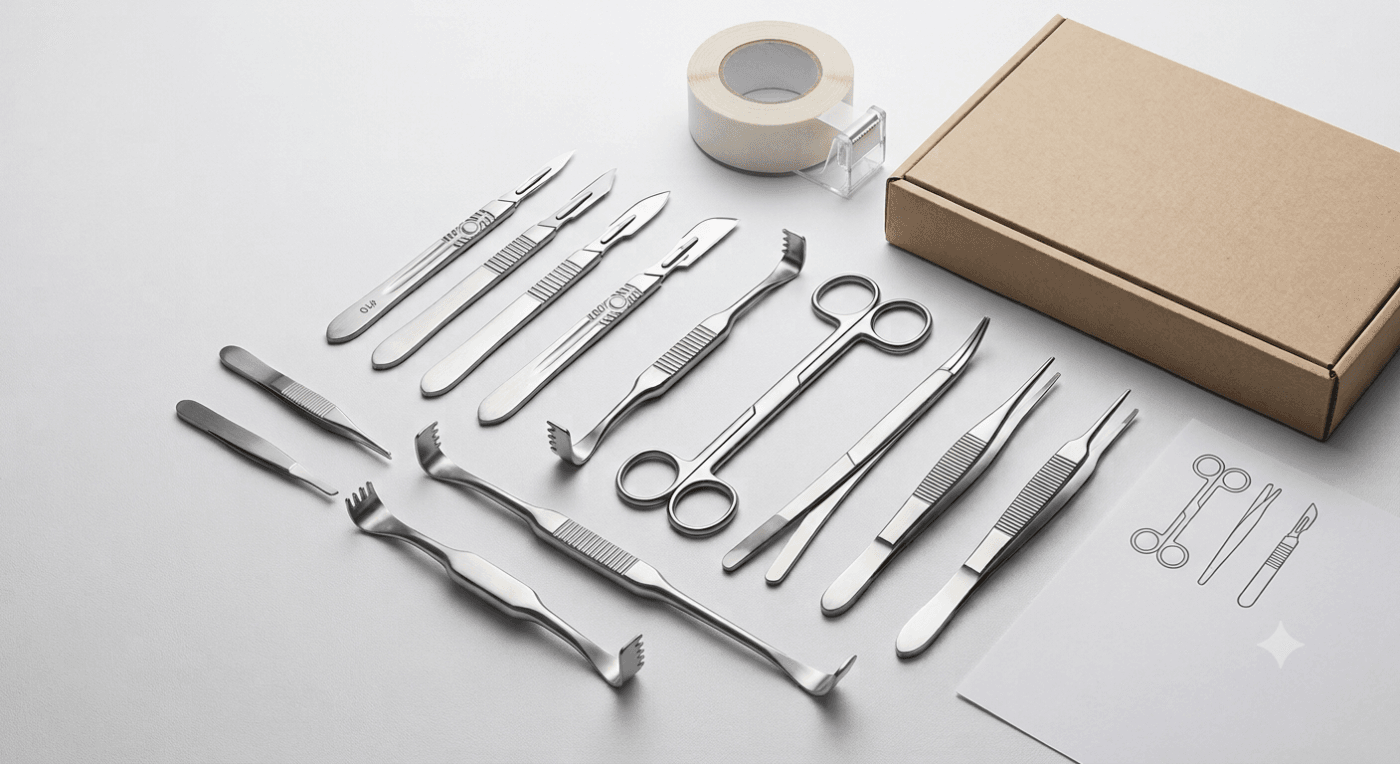
Why UK Distributors Choose Private Label Manufacturing
Private label manufacturing offers a different set of trade-offs compared to reselling an existing brand or building in-house production.
| Sourcing Route | Upfront Cost | Brand Control | Speed to Market | Long-term Value |
|---|---|---|---|---|
| Reselling an existing brand | Low | None-you sell someone else’s name | Fast | Limited-no brand equity built |
| Private label manufacturing | Moderate | Full control over branding and packaging | Moderate-epends on lead times | Strong-builds your own brand over time |
| In-house manufacturing | Very high | Full control | Slow-requires facilities and expertise | Strong, but high capital risk |
Private labelling sits in the middle: lower risk than building your own factory, but far more brand value than simply reselling.
1. Customisation Options
Most private label programmes allow buyers to customise several parts of the finished product.
Common customisation options:
- Laser engraving of company name or logo directly on the instrument
- Branded packaging, boxes, and product inserts
- Custom instrument sets tailored to a specific specialty or customer base
- Choice of finish, satin, mirror, or matte, on stainless steel instruments
Quick tip: Ask any prospective manufacturer for physical samples of their engraving and packaging options before committing to a full production run, photos rarely capture finish quality accurately.
2. Minimum Order Quantities (MOQs)
MOQs vary considerably depending on the manufacturer, instrument type, and level of customisation requested.
Checklist for evaluating MOQs:
- Does the manufacturer offer tiered MOQs (lower for standard engraving, higher for full customisation)?
- Can you start with a smaller test order before scaling up?
- How do the MOQs align with your warehousing and cash flow?
- Are MOQs consistent across reorders, or do they increase with each cycle?
3. Quality and Material Standards
Since your brand name appears on the finished product, manufacturing quality reflects directly on your business.
Look for:
- Surgical-grade stainless steel construction
- Consistent quality control across production batches
- Instruments built to withstand repeated autoclave sterilisation
- Transparent sourcing and batch traceability
4. Regulatory Compliance and Certification
Surgical instruments sold in the UK must meet specific regulatory requirements, regardless of which brand name appears on the product.
Pros and cons of taking on private label regulatory responsibility:
| Pros | Cons |
|---|---|
| Full control over compliance documentation | Legal responsibility sits with the brand owner, not just the manufacturer |
| Ability to build a compliance-led brand reputation | Requires understanding of UKCA marking and MHRA requirements |
| Stronger buyer trust when compliance is handled well | More due diligence needed when vetting manufacturers |
Key considerations:
- UKCA marking requirements for medical devices sold in Great Britain (GOV.UK: Medical devices — conformity assessment and the UKCA mark)
- MHRA registration where applicable (GOV.UK: Regulating medical devices in the UK)
- CE marking where instruments are still sold under relevant EU regulations
- Clear batch documentation and traceability
5. Lead Times and Communication
Step-by-step: what a typical private label order process looks like
- Initial consultation: discuss instrument range, customisation, and estimated volumes
- Sample request: receive physical samples of finish, engraving, and packaging
- Quote and MOQ confirmation: agree pricing, minimum order quantities, and lead times
- Production run: manufacturer produces the order to agreed specifications
- Quality check and dispatch: instruments are inspected, documented, and shipped
- Reorder cycle: future orders typically move faster once specifications are set
Common Challenges in Private Label Sourcing
- Unclear MOQs that don’t scale well with early-stage demand
- Inconsistent quality across production batches from less experienced manufacturers
- Limited regulatory support, leaving compliance entirely on the buyer
- Long or unpredictable lead times affecting distribution schedules
Choosing an experienced, UK-focused manufacturing partner helps avoid each of these from the outset.
How to Choose the Right Private Label Manufacturing Partner: Checklist
- Proven track record in surgical instrument production
- Realistic, tiered MOQs with room to start small
- Surgical-grade stainless steel and consistent quality control
- Familiarity with UKCA marking and MHRA requirements
- Willingness to provide samples before full production
- A single, reliable point of contact for order management
- Clear, realistic lead times communicated upfront
Why Private Labelling Supports Long-Term Brand Growth
Private labelling requires more upfront planning than simple reselling, but it typically provides greater long-term value:
- Stronger brand recognition among your own customer base
- Greater control over pricing and market positioning
- Differentiation from competitors reselling identical products
- A foundation for expanding into new instrument categories under one consistent brand
Role of Metallic Products
Metallic Products manufactures precision-engineered surgical instruments for UK distributors, clinics, and healthcare suppliers looking to build their own branded product range.
Our private label programme includes:
- Surgical-grade stainless steel instruments across dental, surgical, and beauty categories
- Customisable engraving, finishes, and packaging options
- Scalable order volumes suited to both growing and established distributors
- UK-based manufacturing expertise and support with regulatory requirements
Frequently Asked Questions
Private label typically involves customisation specific to the buyer’s brand, such as engraving or packaging, while white label products are usually sold as-is under different labels with minimal customisation.
MOQs vary by manufacturer, instrument type, and customisation level. Many manufacturers offer tiered MOQs, allowing smaller initial orders for standard customisation and higher volumes for fully bespoke designs.
Yes. Regardless of the brand name on the product, surgical instruments sold in the UK must meet applicable regulatory requirements, including UKCA marking where relevant.
Most established manufacturers offer samples before committing to a larger production run, allowing buyers to confirm quality and finish before scaling up.
Lead times vary depending on customisation level and order volume, but a reliable manufacturer should provide clear, realistic timelines upfront for both standard and custom orders.
It can be, provided the manufacturer offers realistic MOQs for smaller initial orders. Starting with a limited product range and scaling gradually reduces upfront risk while still building brand equity.
Conclusion
Understanding private label surgical instruments helps UK distributors, clinics, and healthcare suppliers make informed decisions when building their own branded product range. Customisation flexibility, realistic MOQs, material quality, regulatory compliance, and clear communication all contribute to a successful, long-term manufacturing partnership.
Ready to build your own branded instrument range? Request a private label quote, ask for samples, or get in touch with our team to discuss your requirements.