
Uncategorized
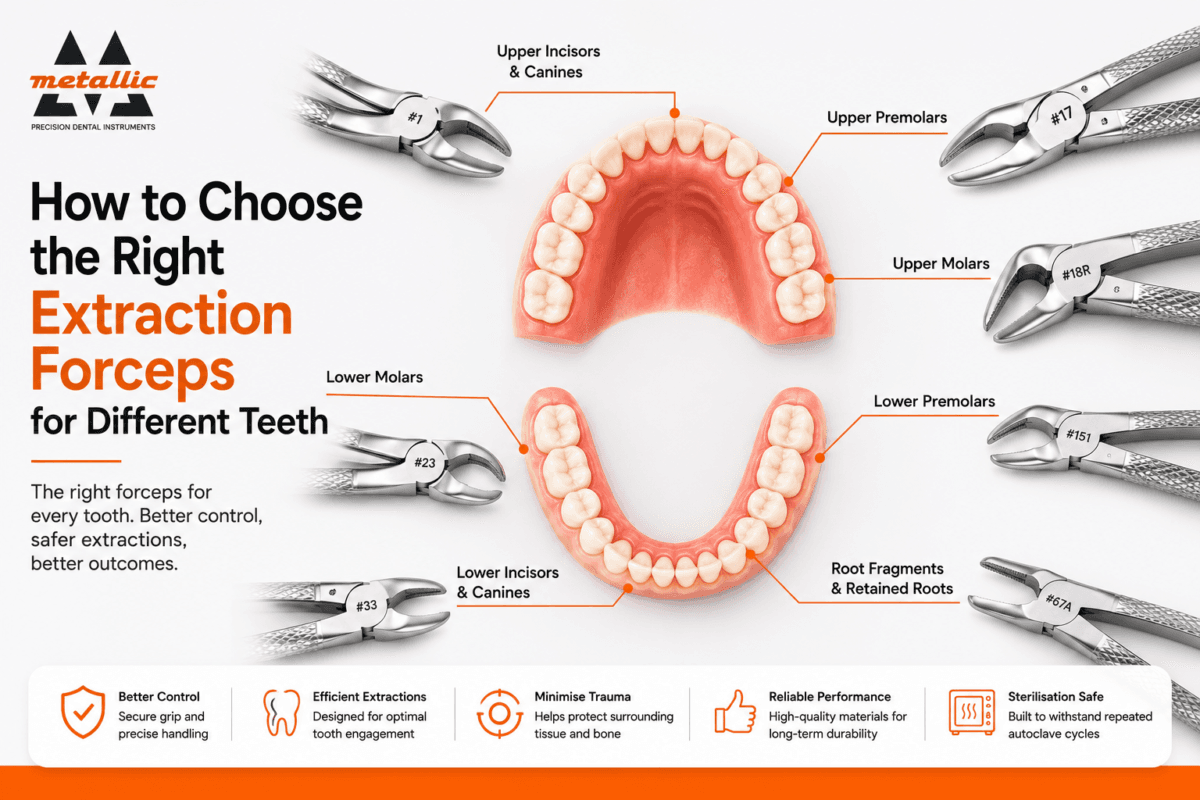
How to Choose the Right Extraction Forceps for Different Teeth
How to Choose the Right Extraction Forceps for Different Teeth
Introduction
Choosing the right extraction forceps is essential for performing safe, efficient, and predictable tooth extractions. Different teeth have unique anatomical characteristics, including root shape, crown structure, and position within the dental arch. As a result, understanding how to choose the right extraction forceps for different teeth can help dentists improve clinical control, reduce complications, and achieve better treatment outcomes.
Modern dental practices rely on a variety of extraction forceps specifically designed for different tooth groups. Selecting the appropriate instrument not only improves extraction efficiency but also helps preserve surrounding tissues and minimise patient discomfort.
Why Forceps Selection Matters
Extraction forceps are designed to adapt to specific tooth anatomies. Using the correct forceps allows clinicians to achieve a secure grip while applying controlled extraction forces.
Proper forceps selection can help:
- Improve tooth engagement
- Reduce the risk of crown fracture
- Enhance extraction efficiency
- Minimise trauma to surrounding tissues
- Improve clinician control
Therefore, selecting the appropriate forceps is a key part of successful tooth extraction procedures.
Understanding Dental Extraction Forceps
Dental extraction forceps are designed with specific beak shapes and handle configurations that correspond to particular teeth and root anatomies.
Factors influencing forceps selection include:
- Tooth location
- Root morphology
- Crown condition
- Access requirements
- Clinical complexity
Consequently, most dental practices maintain a range of forceps to accommodate different extraction scenarios.
Forceps for Upper Incisors and Canines
Maxillary incisors and canines generally have single roots and relatively straightforward anatomy.
Characteristics Required
Forceps used for these teeth should provide:
- Secure crown adaptation
- Controlled rotational movement
- Precise handling
Clinical Benefits
Using appropriately designed forceps helps:
- Improve grip stability
- Reduce crown damage
- Enhance extraction control
As a result, clinicians can perform anterior extractions more efficiently.
Forceps for Upper Premolars
Upper premolars can present unique challenges because some teeth may have bifurcated roots.
Considerations
Clinicians should consider:
- Root anatomy variations
- Risk of root fracture
- Crown condition
Forceps Requirements
Appropriate forceps should provide:
- Secure adaptation
- Controlled pressure distribution
- Reliable access
Therefore, selecting forceps specifically designed for premolars can improve extraction outcomes.
Forceps for Upper Molars
Maxillary molars typically have multiple roots and more complex anatomy.
Key Requirements
Forceps for upper molars should offer:
- Strong engagement
- Proper adaptation to molar anatomy
- Effective control during luxation and extraction
Clinical Advantages
The correct instrument helps:
- Improve procedural efficiency
- Reduce slippage
- Minimise unnecessary force
Consequently, clinicians can manage molar extractions with greater confidence.
Forceps for Lower Incisors and Canines
Mandibular anterior teeth often require different extraction mechanics compared to maxillary teeth.
Instrument Considerations
Suitable forceps should provide:
- Accurate adaptation
- Stable grip
- Controlled movement
Benefits
Using the correct forceps helps ensure:
- Better tooth engagement
- Improved clinician control
- More predictable extractions
As a result, treatment can proceed more smoothly.
Forceps for Lower Premolars
Lower premolars typically have single roots but may vary in root shape and angulation.
Ideal Forceps Features
- Precise beak adaptation
- Comfortable handling
- Reliable grip
These features help clinicians perform efficient and controlled extractions.
Forceps for Lower Molars
Mandibular molars often require forceps capable of handling larger crowns and multiple roots.
Important Characteristics
Forceps should provide:
- Strong grip strength
- Proper adaptation to molar anatomy
- Excellent leverage
Clinical Benefits
The correct instrument can:
- Improve extraction efficiency
- Reduce procedural difficulty
- Support predictable outcomes
Therefore, lower molar extractions often benefit from dedicated molar forceps designs.
Root Forceps for Retained Roots and Fragments
Retained roots and fractured root fragments frequently require specialised instruments.
Why Root Forceps Matter
Root forceps are designed to:
- Access confined spaces
- Engage remaining root structure
- Improve fragment retrieval
As a result, they are valuable additions to any extraction instrument set.
Factors to Consider When Choosing Extraction Forceps
When selecting extraction forceps, clinicians should evaluate several important factors.
Tooth Anatomy
Different root shapes and crown structures require different forceps designs.
Access and Visibility
Posterior teeth often demand instruments that provide improved access.
Crown Condition
Damaged teeth may require specialised extraction approaches.
Clinical Experience
Personal technique and experience can influence forceps preference.
Because of these variables, no single forceps design is suitable for every extraction.
What Makes a High-Quality Dental Extraction Forceps?
When purchasing extraction forceps, dental professionals should look for:
Premium Stainless Steel Construction
Supports durability, corrosion resistance, and long-term performance.
Precision Beak Alignment
Ensures reliable engagement and control.
Strong Box Joint Construction
Maintains stability during repeated use.
Ergonomic Handle Design
Helps reduce hand fatigue and improve comfort.
Sterilisation Compatibility
Supports long-term reliability through repeated autoclave cycles.
Consequently, high-quality forceps often provide better value over time.
Common Forceps Selection Mistakes
Many clinicians encounter challenges when forceps selection does not match the clinical situation.
Common mistakes include:
- Using one forceps design for multiple tooth types
- Ignoring root anatomy
- Choosing instruments based solely on cost
- Overlooking instrument quality
- Failing to maintain a complete extraction kit
As a result, procedural efficiency and treatment outcomes may be affected.
Why Dental Practices Maintain a Variety of Forceps
Successful practices often maintain a comprehensive selection of extraction forceps because:
- Different teeth require different instruments
- Clinical situations vary
- Efficiency improves with proper instrument selection
- Treatment outcomes become more predictable
Therefore, investing in a range of high-quality forceps supports clinical flexibility.
Role of Metallic Products
Metallic Products manufactures precision-engineered dental extraction forceps designed for modern clinical requirements.
Features include:
- Premium stainless steel construction
- Precision-aligned beaks
- Durable box joint mechanisms
- Ergonomic designs
- Reliable long-term performance
This helps dental professionals perform extractions with confidence, efficiency, and control.
Conclusion
Understanding how to choose the right extraction forceps for different teeth is essential for achieving efficient and predictable extractions. Because tooth anatomy varies significantly throughout the mouth, selecting forceps specifically designed for each tooth group can improve control, reduce complications, and support better clinical outcomes.
By investing in high-quality extraction forceps and maintaining a comprehensive instrument selection, dental practices can enhance procedural efficiency and provide a higher standard of patient care.