
Surgical Instruments
How to Handle Surgical Clamps Safely: A Hospital and Clinic Guide
How to Handle Surgical Clamps Safely: A Hospital and Clinic Guide
Introduction
Understanding how to handle surgical clamps safely is essential for every surgeon, nurse, and clinical team member working in hospitals, clinics, and theatres. Surgical clamps are used to control bleeding, occlude vessels, and hold tissue securely during procedures, so correct handling directly affects both patient safety and procedural efficiency. Whether used in general surgery, gynaecological procedures, or emergency settings, proper technique reduces risk, protects the instrument, and supports a smoother workflow for the entire surgical team.
Why Proper Handling Matters
Surgical clamps apply direct, controlled pressure to tissue or vessels, often in situations where precision and timing are critical. Mishandling a clamp, whether through incorrect grip, improper locking, or careless placement, can lead to tissue damage, instrument failure, or delays during a procedure.
Correct handling helps clinical teams:
- Apply consistent, controlled pressure
- Reduce the risk of accidental tissue trauma
- Maintain a secure hold throughout the procedure
- Support faster, safer instrument handoffs
- Extend the working life of the clamp itself
As a result, understanding proper clamp handling is an important part of both surgical training and day-to-day clinical practice.
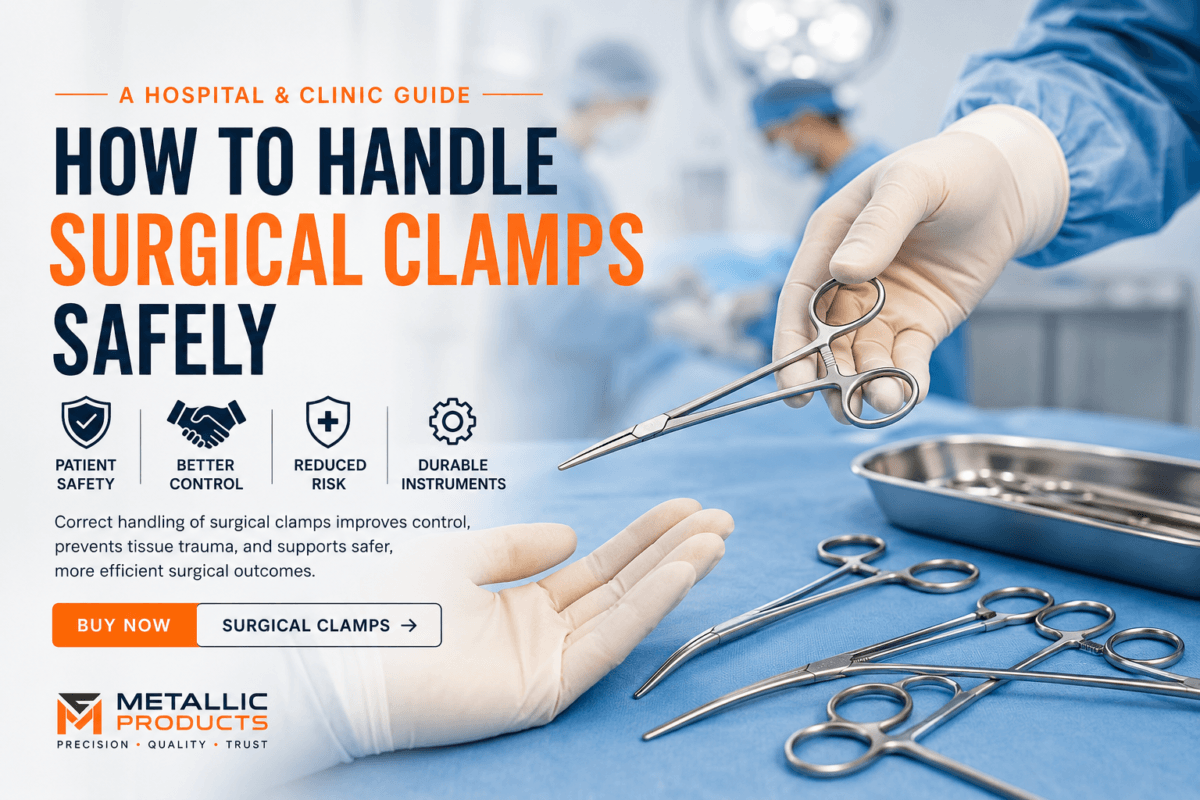
How Handling Technique Affects Outcomes
Not all handling approaches offer the same level of safety and control.
Correct technique offers:
- A secure, stable grip during application
- Predictable locking and release
- Reduced risk of slippage under tension
- Consistent pressure across the clamped area
In contrast, poor handling can lead to uneven pressure, accidental release, or unnecessary tissue trauma.
1. Correct Grip and Finger Placement
How a clamp is held directly affects control during application.
Proper grip technique involves:
- Placing the thumb and ring finger through the rings, not the fingertips alone
- Using the index finger to stabilise and guide the shaft for precision
- Maintaining a relaxed, steady hold rather than gripping too tightly
- Adjusting grip based on the clamp’s size and the procedure being performed
Consequently, correct finger placement improves both control and reduces hand fatigue during longer procedures.
2. Understanding the Ratchet Mechanism
Most surgical clamps use a ratchet locking mechanism to hold their grip once closed.
Safe use of the ratchet involves:
- Closing to the first ratchet notch for lighter, more delicate tissue
- Using further notches only when a firmer hold is clinically necessary
- Releasing the ratchet fully before repositioning, rather than forcing the clamp
- Checking the ratchet engages securely before releasing the handles
Furthermore, understanding how much pressure each ratchet notch applies helps prevent unnecessary tissue damage.
3. Safe Application and Placement
Where and how a clamp is applied affects both safety and surgical outcome.
Safe application includes:
- Confirming the correct clamp type and size for the target vessel or tissue
- Applying the clamp perpendicular to the vessel unless otherwise indicated
- Avoiding excessive surrounding tissue in the jaws
- Communicating clearly with the surgical team when placing or removing a clamp
Therefore, careful placement reduces the risk of complications and supports a more controlled procedure.
4. Safe Handoffs and Instrument Passing
Clamps are frequently passed between surgeon and scrub nurse during a procedure, making safe handoff technique essential.
Safe handoff practice includes:
- Passing the clamp handle-first, ratchet closed
- Using a firm, deliberate motion rather than a rushed pass
- Confirming the receiving hand has a secure grip before releasing
- Avoiding passing over the surgical field where possible
As a result, safe handoffs reduce the risk of dropped instruments and maintain a sterile, controlled field.
5. Cleaning, Sterilisation, and Inspection
Proper handling extends beyond the procedure itself into how clamps are cleaned and maintained.
Good practice includes:
- Rinsing instruments promptly after use to prevent debris from drying onto the surface
- Inspecting the ratchet and jaws for wear or misalignment before sterilisation
- Following standard autoclave sterilisation protocols for surgical-grade stainless steel
- Removing any clamp from circulation if the ratchet no longer holds securely
Consequently, proper post-procedure handling protects both patient safety and the instrument’s long-term reliability.
Common Mistakes in Clamp Handling
Common handling mistakes include:
- Gripping the clamp too tightly, leading to hand fatigue and reduced control
- Forcing the ratchet closed beyond what the tissue requires
- Passing instruments carelessly during handoffs
- Failing to inspect the ratchet mechanism for wear over time
- Reusing a clamp with a loose or unreliable lock
These issues can affect both procedural safety and the instrument’s working lifespan.
How to Handle Surgical Clamps Safely: Key Principles
When handling surgical clamps, keep the following principles in mind:
Correct Grip
Use the thumb and ring finger through the rings, with the index finger guiding the shaft.
Appropriate Ratchet Tension
Apply only as much locking pressure as the tissue and procedure require.
Careful Placement
Confirm clamp type, size, and positioning before application.
Safe Handoffs
Pass instruments handle-first with a firm, deliberate motion.
Regular Inspection
Check the ratchet and jaws for wear before and after sterilisation.
Why Training and Technique Matter
Although surgical clamps are a familiar, everyday instrument, consistent handling technique remains an important part of both training and ongoing practice.
Benefits of correct technique include:
- Reduced risk of tissue trauma or complications
- More efficient, predictable procedures
- Longer instrument lifespan through reduced wear
- Stronger coordination between surgeons and surgical teams
Therefore, reinforcing proper clamp handling supports both patient safety and departmental efficiency.
Role of Metallic Products
Metallic Products manufactures precision-engineered surgical instruments designed to support safe, reliable handling in hospital and clinic settings.
Our surgical clamps feature:
- Precision-aligned jaws for a secure, consistent hold
- Reliable ratchet mechanisms built for repeated use
- Surgical-grade stainless steel construction
- Durable build quality suited to frequent sterilisation
These features help surgical teams handle every procedure with confidence and control.
FAQ
Pressure should be appropriate to the tissue and procedure, generally starting with the first ratchet notch for delicate tissue and only increasing when clinically necessary.
Clamps should be inspected before and after every sterilisation cycle, checking the ratchet mechanism and jaw alignment for signs of wear.
Pass the clamp handle-first with the ratchet closed, using a firm and deliberate motion, and confirm the receiving hand has a secure grip before releasing.
No, a clamp with a loose or unreliable ratchet should be removed from circulation and assessed, as it may no longer hold a secure grip during use.
Conclusion
Understanding how to handle surgical clamps safely helps surgical teams appreciate the importance of correct grip, appropriate ratchet tension, careful placement, and safe handoff technique. These principles reduce the risk of complications, support more efficient procedures, and extend the working life of the instruments themselves.
By reinforcing proper handling technique and maintaining clamps correctly, hospitals and clinics can improve both patient safety and day-to-day surgical efficiency.