
Beauty Instruments, Metallic Blogs
Lash Extension Tweezers: How to Choose the Best Lash Tweezers for Classic, Volume and Isolation Work
Oct
By Metallic Products Limited
Your tweezers are the most important tool in a lash artist’s kit. Glue, lashes and lamps all matter, but every single lash you place passes through a pair of lash extension tweezers, and the wrong pair will slow you down, tire your hands and cost you retention. The right pair feels like an extension of your fingers.
The trouble is that choosing is confusing. Search for lash tweezers and you will find straight, curved, 45 degree, 90 degree, boot, L-shaped, fibre tip, gold, pink, black and more, often with very little explanation of what each one is actually for.
This guide breaks it all down. Whether you are a beginner buying your first set, a mobile lash tech building a kit, or a salon owner restocking a team, you will learn how the different types of lash tweezers work, which ones suit classic, volume and mega volume styles, how to look after them, and what to check before you buy.
What Are Lash Extension Tweezers?
Lash extension tweezers (also called lash tech tweezers, lash applicator tweezers, false lash tweezers or simply tweezers for lash extensions) are precision tools used to isolate natural lashes and to pick up and place extensions onto them.
They are not the same as brow or beauty tweezers. Lash tweezers are made with much finer, more accurately aligned tips, because you are working with a natural lash that may be less than a tenth of a millimetre wide. Tips that do not meet perfectly will let lashes slip, cause stickies and force you to re-do work.
The Two Jobs: Isolation vs Placement
Almost every lash set uses two pairs of tweezers at once, one in each hand, and they do different jobs.
1. Isolation tweezers. Used in your non-dominant hand to separate a single natural lash from its neighbours. This is what people mean by isolating lashes or lash isolation. Clean isolation is the foundation of a safe, long-lasting set.
2. Placement (application) tweezers. Used in your dominant hand to pick up an extension or a handmade fan, dip it in adhesive and place it on the isolated natural lash.
Some tweezers are designed specifically for one job. Others, particularly straight fine-tip pairs, can do either. Knowing which job you are buying for is the first step to choosing well.
Different Types of Lash Tweezers Explained
Here is a plain-English guide to the types of lash tweezers you will see for sale, and what each is best at.
Straight Lash Tweezers
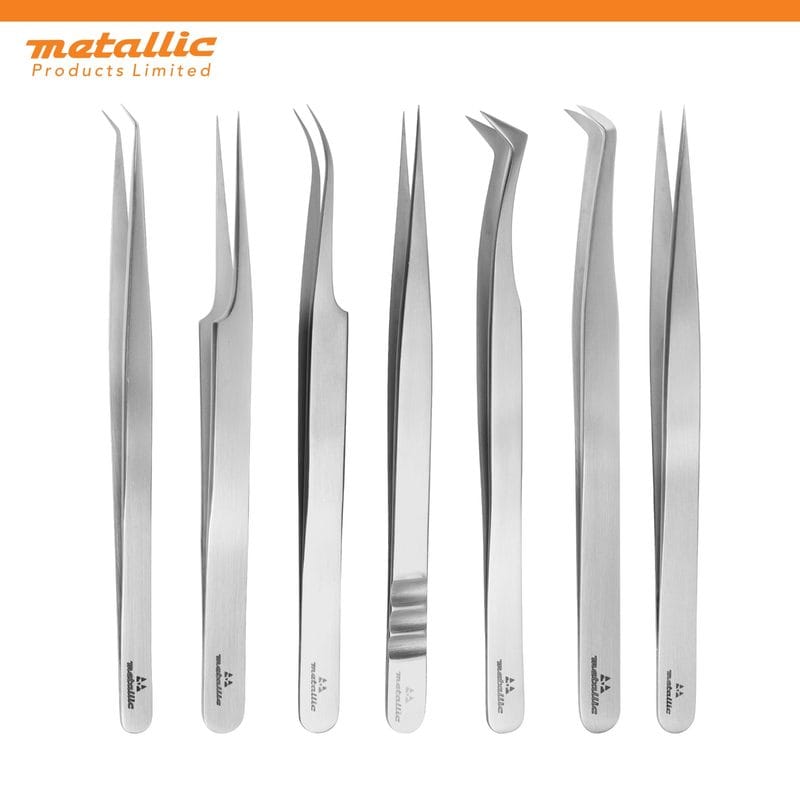
Straight lash tweezers are the classic all-rounder. The tips run in a straight line from the body, which gives a clear view of the lash line and makes them the most popular choice for isolation. Many artists use a straight pair as their isolation tweezers and a different shape for placement.
Shop straight and isolation pairs: Straight Lash Extension Tweezers, Professional Isolation Lash Tweezers and Pro Straight Lash Tweezers (Salon Grade).
Curved Lash Tweezers
Curved lash tweezers have a gentle curve toward the tip. This makes it easier to pick up lashes from a tray at a comfortable wrist angle and to bring them to the eye without twisting your hand. They are a popular choice for volume lash placement.
Shop curved pairs: Mini Curved Eyelash Extension Tweezer (Anti-Static) and Semi Curved Lash Extension Tweezer.
45 Degree Lash Tweezers
45 degree angle lash tweezers are one of the most widely used placement shapes. The angled tip lets you approach the natural lash from the side, keeps your hand out of your line of sight and suits both classic and volume work. If you are unsure where to start, a 45 degree pair is a sensible first purchase.
Shop 45 degree pairs: 45° Lash Extension Tweezers, Short Tip Diamond Grip and Individual Eyelash Extension Tweezers, Swiss Quality 45° Fanning.
90 Degree and L-Shaped Lash Tweezers
90 degree lash tweezers (also sold as L-shaped lash tweezers) have a sharp right-angle bend at the tip. They are used for isolation and placement in awkward spots, and many artists find them very precise for lifting a lash out of a crowded group. They take a little getting used to, so they are often a second or third pair rather than a first.
Shop L-shaped pairs: Diamond Grip L-Shaped Angled Tip Tweezers and Pro Eyelash Extensions Tweezer, Angled Curved Pointed L-Type.
Boot Lash Tweezers
Boot lash tweezers have a distinctive bent tip that resembles the foot of a boot. They are designed for controlled pickup of fans and for sliding in under dense natural lashes, and they are popular for volume work.
Shop boot-style tweezers: Professional Lash Tweezers, Curved Tip Anti-Static Isolation Boot.
Angled Lash Tweezers
You will also see tweezers simply labelled angled lash tweezers. This usually means a tip bent somewhere between roughly 30 and 60 degrees. Check the stated angle or product photos so you know exactly what you are getting.
Fibre Tip Lash Tweezers
Fibre tip lash tweezers (also written fiber tip lash tweezers or fiber grip lash tweezers) have a textured or fibre-style gripping surface at the tip. The extra grip helps with picking up lash trays and holding fans firmly. They are often chosen for handmade fans, though some artists prefer a smooth tip for fine isolation. This is a matter of personal feel.
See the current fibre tip options in our eyelash tweezers range.
Diamond Grip Tweezers
Diamond grip volume lash tweezers have a fine, grooved texture on the inside of the tip to stop fans from slipping. If you struggle to hold lightweight fans in place, a textured grip is worth trying.
Try our diamond grip 45° short tip or L-shaped pairs.
Tweezers for False Lashes and Lash Applicators
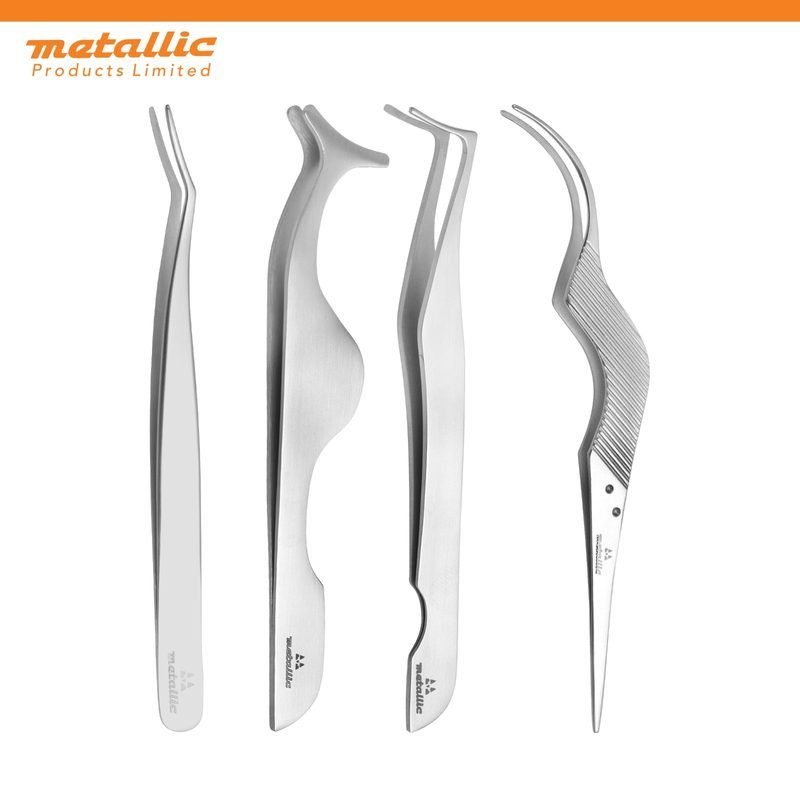
Not every pair is for professional extension work. Tweezers for false lashes (also called false lash tweezers or lash applicator tweezers) are designed for strip lashes and DIY clusters at home. They are usually curved and easy to handle, so you can place a strip or cluster without a steady salon-level technique. Options include the False Eyelash Applicator for Strip Lashes, the Eyelash Applicator Tool for DIY Cluster Lashes, and the multi-function False Eyelash Applicator Tool with Clip and Nipper.
Best Lash Tweezers by Lash Style
There is no single “best” pair for everyone, because the best choice depends on the style you offer. Here is a practical starting point.
Best Tweezers for Classic Lashes
Classic (one extension to one natural lash) is the most forgiving style, so classic lash tweezers do not need to be exotic. A good approach is:
- Isolation: straight, fine-tip tweezers
- Placement: 45 degree or slightly curved tweezers with a firm but gentle grip
This combination is also the answer to the best lash tweezers for beginners: two reliable, well-made pairs you can learn on before specialising.
A starter pair from our range: the Straight Lash Extension Tweezers for isolation and the 45° Short Tip Diamond Grip Tweezers for placement.
Best Tweezers for Volume Lashes and Making Fans
Volume lash tweezers are used to pick up several extensions and place them as one fan on a single natural lash. For fanning lashes and handmade fans, look for:
- Very fine tips that close together with no gap
- A light, balanced body that does not tire your hand
- A tip shape you can rotate comfortably (curved, 45 degree or boot are all popular)
Some artists make fans with a fibre tip or diamond grip pair for extra hold, while others prefer a smooth stainless tip for speed. Trying both is the only way to know.
For fanning, see our Volume Lash Fanning Tweezers (Straight).
Best Tweezers for Russian Volume
Russian lash tweezers (also called Russian volume lash tweezers) are used for the 2D to 6D fans typical of Russian volume. The priority here is precision. The tips must close perfectly so that the fine bases of the extensions stay together while you dip and place them.
Our Russian 3D 6D Volume Lash Tweezers (L-Shape, Needle Nose, Angled) are made for this style.
Best Tweezers for Mega Volume
Mega volume lash tweezers handle very fine, lightweight fans of ten or more extensions, so tip alignment matters even more. Look for ultra-fine tips with light, consistent spring tension. A pair that is slightly too stiff will crush or splay a delicate fan.
Best Lash Isolation Tweezers
Isolation is where many new artists lose time, so it deserves its own section. Good isolation tweezers for lash extensions should:
- Have a fine, sharp tip that can slip between two lashes without catching either
- Close cleanly, with no light visible between the tips
- Grip a single natural lash without pulling or bending it
- Feel balanced, so you can hold a lash steady for several seconds without hand fatigue
Straight tweezers are the most common choice for isolating lashes. 90 degree and L-shaped pairs help with crowded or stubborn lashes. If you struggle to separate lashes at the inner corner, try a small, fine-tip pair: inner corner lash tweezers (often a slim straight or angled tip) let you reach the short, hard-to-see lashes at the edge of the eye without bumping the skin or the nose bridge.
Does Colour Matter? Gold, Pink, Black and Rose Gold Tweezers
You will see gold lash tweezers, rose gold lash tweezers, pink lash tweezers and black lash tweezers everywhere. In most cases, the colour is a surface coating or plating over stainless steel, and it is mainly cosmetic.
What colour can do:
- Make your kit look polished and professional, which matters to clients
- Help you tell your isolation pair from your placement pair at a glance
- Add a little corrosion protection, depending on the coating
What colour does not do is make a poorly aligned pair perform better. Always judge tweezers on tip precision, grip and balance first, and colour second. Coated tweezers can also be more sensitive to harsh cleaning or scratching, so follow the maker’s care guidance.
What to Look for in Professional Lash Tweezers
Whether you are buying professional lash extension tweezers for yourself or for a team, check these points:
- Material. High-quality stainless steel is the standard. It resists rust, holds a fine tip and can be disinfected properly.
- Tip alignment. Close the tips and hold them to the light. You should see no gap.
- Spring tension. The tweezers should open and close smoothly with light pressure. Too stiff and your hand tires; too loose and lashes slip.
- Weight and balance. Lighter is not always better, but the pair should sit comfortably in your fingers across a two to three hour appointment.
- Tip finish. Smooth, fibre or diamond grip, depending on your technique.
- Manufacturer quality. Consistent machining is what separates a good pair from one that needs replacing in a few weeks.
A note on brands: names such as Vetus, Dumont, Lash FX and others are well known in the lash world, and many artists have strong loyalties. Trying a few shapes from different makers is the best way to find what suits your hands. Whatever you choose, judge the tweezers, not the logo.
How to Clean and Sanitise Lash Tweezers
Hygiene is not optional. Tweezers touch the client’s lash line and adhesive, so cleaning lash tweezers between every client is essential, and it also keeps your tools performing well.
Removing adhesive. Cured glue builds up on the tips and affects grip. Wipe the tips with a lint-free wipe or a dedicated lash tweezer cleaner (many artists also use a glue remover designed for tools) as soon as you notice residue. Do not scrape the tips with anything hard, as this can damage the finish.
Sanitising. Between clients, clean and disinfect your tweezers according to your local regulations and your insurer’s guidance. A lash tweezer sanitiser or approved disinfectant is commonly used. Always follow the instructions on the product, and check that your tweezers’ material and coating are compatible with the method you use, whether that is liquid disinfectant, a UV cabinet or another approved method.
Storing. Keep tweezers in a case or holder so the tips cannot be bent or knocked. A lash extension tweezer case, holder or kit protects the points, which matters because even a slight bend can ruin alignment.
If you notice the tips no longer meet cleanly, or the grip has weakened despite cleaning, it is time to replace the pair rather than struggle on.
For general care guidance, see our Instruments Care page.
Building Your Lash Tweezer Kit
If you are putting together a lash extension tweezer kit, here is a simple way to build up:
Starter kit (beginners)
- 1 straight isolation tweezer
- 1 placement tweezer (45 degree or curved)
- A case or holder
- Tweezer cleaner and sanitiser
Working kit (classic and volume)
- 2 straight isolation tweezers (one spare)
- 1 to 2 placement tweezers in different shapes (for example, curved and 45 degree)
- 1 fibre tip or diamond grip pair for fans
Advanced kit (mega volume and speciality)
- Add a 90 degree or L-shaped pair, a boot pair and an ultra-fine mega volume pair, based on what you actually find yourself reaching for
This is also why lash and tweezers go together as a buying decision: your adhesive, your lash type and your tweezers all affect each other. A faster-curing glue, for example, rewards a pair of tweezers that lets you pick up and place without hesitating.
Where to Buy Lash Tweezers
Online or near you? Searching for lash tweezers near me will show beauty wholesalers and salons, but the specialist choice in store is often limited, and it can be hard to compare shapes side by side. Buying online gives you far more range, and you can read the full specification before you commit.
Marketplaces vs specialist suppliers. Large marketplaces such as Amazon list a huge range of lash tweezers at many price points. That variety is helpful, but quality varies a great deal and it can be hard to tell who actually made the product. If you want consistent quality, buying from a manufacturer or specialist instrument supplier gives you clearer information about materials and finish.
Buying in bulk. If you run a salon or training academy, buying lash tweezers in bulk can save money and keeps your whole team using matched tools. It also makes it easier to replace pairs quickly when they wear out.
Custom and personalised tweezers. Many lash businesses like personalised or custom lash tweezers (for example, with a branded finish or engraving) as a way to stand out or as gifts for graduates. If this appeals to you, ask your supplier what customisation options are available.
See our Custom Product Solutions page for more.
At Metallic Products, we have been making precision dental, surgical, beauty and diagnostic instruments in the UK for years, and the same standards of tip accuracy and finish matter just as much for lash work. Browse our full eyelash tweezers range to see what we offer for lash artists, with free UK delivery on all orders.
Frequently Asked Questions
There is no single best pair. Most artists use a straight fine-tip pair for isolation and a 45 degree, curved or boot pair for placement. The best choice depends on your technique and the lash style you offer.
Fine-tip volume lash tweezers that close with no gap, with light tension and a tip shape that lets you pick up and rotate fans comfortably. Curved, 45 degree and boot shapes are all popular.
Isolation tweezers separate and hold a single natural lash. Volume tweezers pick up and place extensions or handmade fans. Most artists use one of each at the same time.
Neither is better outright. A 45 degree pair is easier to learn and very versatile, while a 90 degree pair offers precise control in tight spaces. Many experienced artists own both.
They provide extra grip, which helps with picking up trays and holding fans. Some artists love them for volume, while others prefer smooth tips. It comes down to personal preference.
Start with a straight isolation pair and a 45 degree or curved placement pair from a reliable maker. Learn the basics before adding specialist shapes.
Wipe adhesive from the tips as soon as it builds up, using a lint-free wipe or a dedicated tweezer cleaner. Sanitise between every client using a method suitable for your tweezers and permitted by your local regulations.
Replace them when the tips no longer align, the grip weakens or the tips are bent or damaged. Good care extends their life, but tweezers are a working tool and will eventually wear.
Final Thoughts
The right lash extension tweezers make every appointment faster, cleaner and more comfortable. Start by deciding whether you need an isolation pair, a placement pair or both, match the tip shape to the style you offer, and always check tip alignment and build quality before you commit. Look after them, keep them clean and stored safely, and they will serve you for a long time.
Ready to build or refresh your kit? Explore our eyelash tweezers and the wider beauty instruments range at Metallic Products and find precision tools made for professionals.