
Beauty Instruments, Uncategorized
Nail Technician Starter Kit UK: The Core Tools to Buy First
Sep
Nail Technician Starter Kit UK: The Core Tools to Buy First
Quick Answer
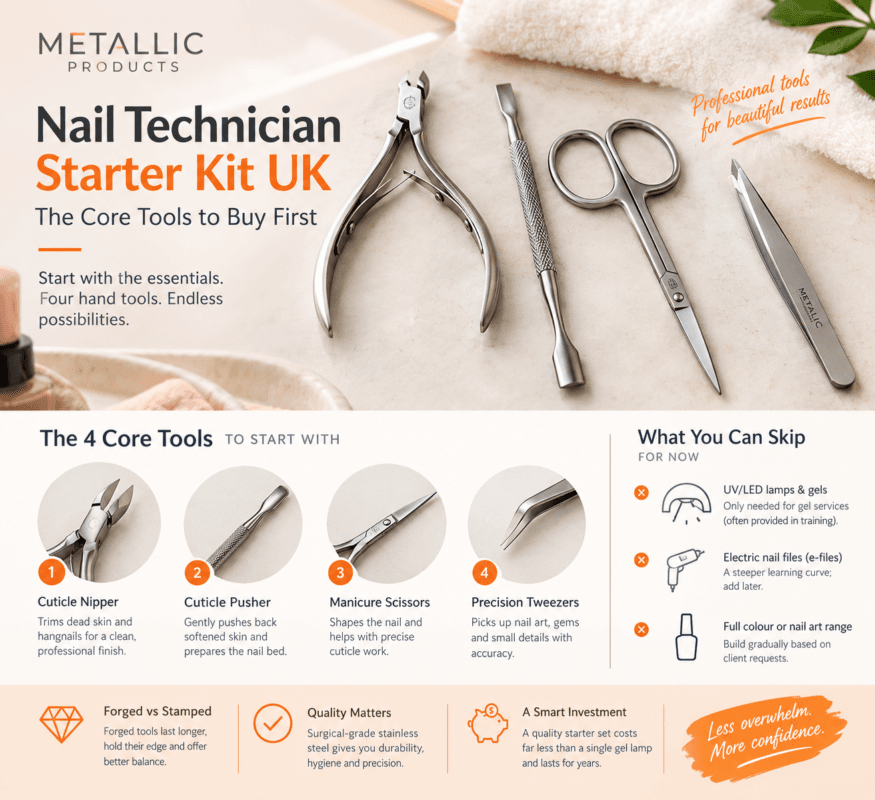
A nail technician starter kit should begin with four hand tools: a cuticle nipper, a cuticle pusher, manicure scissors, and precision tweezers, all in surgical-grade stainless steel. These cover the majority of manicure and pedicure work. Everything else, including lamps, gels, and electric files, can wait until you know which services you’ll actually offer.
Introduction
Building a nail technician starter kit for the first time is overwhelming. Course providers, salons, and suppliers all suggest different lists, many padded with equipment you won’t need for months. This guide strips it back to what genuinely matters on day one: the hand tools you’ll use in nearly every appointment, what separates a good one from a poor one, and what you can safely leave until later.
In this guide:
- The four core tools to start with
- Forged vs stamped: the quality distinction most beginners miss
- What you can skip for now
- Frequently asked questions
The Four Core Tools to Start With
1. Cuticle Nipper
Your cuticle nipper is arguably the tool you’ll reach for most. It trims dead skin and hangnails around the nail bed, and the difference between a clean result and a torn, uneven one usually comes down to this single tool. Jaw sizes typically range from 3mm to 5mm; a smaller jaw offers more control while you’re still building precision, with larger sizes useful later for faster general work.
2. Cuticle Pusher
Used before the nipper, a cuticle pusher gently pushes back softened skin to expose more of the nail bed. Double-ended designs, with a rounded end and an angled or flat end, cover both general pushing and detail work in tight corners with one tool.
3. Manicure Scissors
Where nippers handle dead skin, scissors shape the free edge of the nail itself and support detailed cuticle trimming. Curved blades follow the natural curve of the nail and cuticle, making them well suited to hangnail removal, while straight blades give more control for precise, even shaping.
4. Precision Tweezers
Tweezers become an extension of your hand for lifting stray nail art pieces, foils, and gems into exact position. Well-made tweezers have tips that align perfectly along their full length; misaligned tips are one of the most common frustrations with lower-quality kits.
Forged vs Stamped: The Distinction Most Beginners Miss
Not all cuticle tools are made the same way, and this matters more than most starter guides mention. Stamped tools are cut from a flat sheet of metal, with the two halves joined at a pivot point afterward. They’re cheaper to produce, but the joint loosens with use and the blade dulls quickly. Forged tools are shaped from a single piece of steel, giving a stronger, better balanced instrument that holds its edge far longer under repeated sterilisation. When comparing kits, this construction difference is often a better indicator of real quality than price alone.
What You Can Skip for Now
Not everything on a typical “complete kit” list needs buying immediately:
- UV/LED lamps and gel systems: only needed once you’re offering gel services, and often provided during training
- Electric nail files (e-files): a steeper learning curve; most technicians start with hand tools and add an e-file once fundamentals are solid
- A full colour or nail art supply range: build this gradually based on what clients actually request
Starting lean with the four core hand tools keeps initial costs down while you’re still developing technique.
Frequently Asked Questions
A quality cuticle nipper is used in nearly every appointment, making it one of the highest value purchases in a first kit.
Forged tools cost more upfront but hold their edge and structural integrity far longer, making them better value over a working career rather than a one off saving.
Not immediately. A single mid size jaw, around 4mm to 5mm, handles most general work, with additional sizes added as you encounter specific client needs.
A quality starter set covering a nipper, pusher, scissors, and tweezers typically costs a fraction of a single gel lamp, while lasting years with proper care.
Curved blades suit cuticle work and hangnail removal, while straight blades give more precise control for shaping the nail edge; many technicians eventually carry both.
A Practical Way to Start
Rather than sourcing each tool separately, a compact kit such as the Pocket-Sized Manicure & Pedicure Tools Kit covers a cuticle nipper, scissors, nail file, and tweezers in one purchase, in surgical grade stainless steel, a practical way to start before building out individual tools by preference.
Conclusion
A nail technician starter kit doesn’t need to be complicated or expensive to be effective:
- Start with a cuticle nipper, pusher, manicure scissors, and tweezers
- Understand the forged vs stamped distinction before comparing prices
- Skip lamps, gels, and e-files until you’re ready for those services
- Build out your kit gradually as your client needs become clearer
Explore our full range of cuticle nippers, manicure scissors, and beauty instruments.