
Surgical Instruments
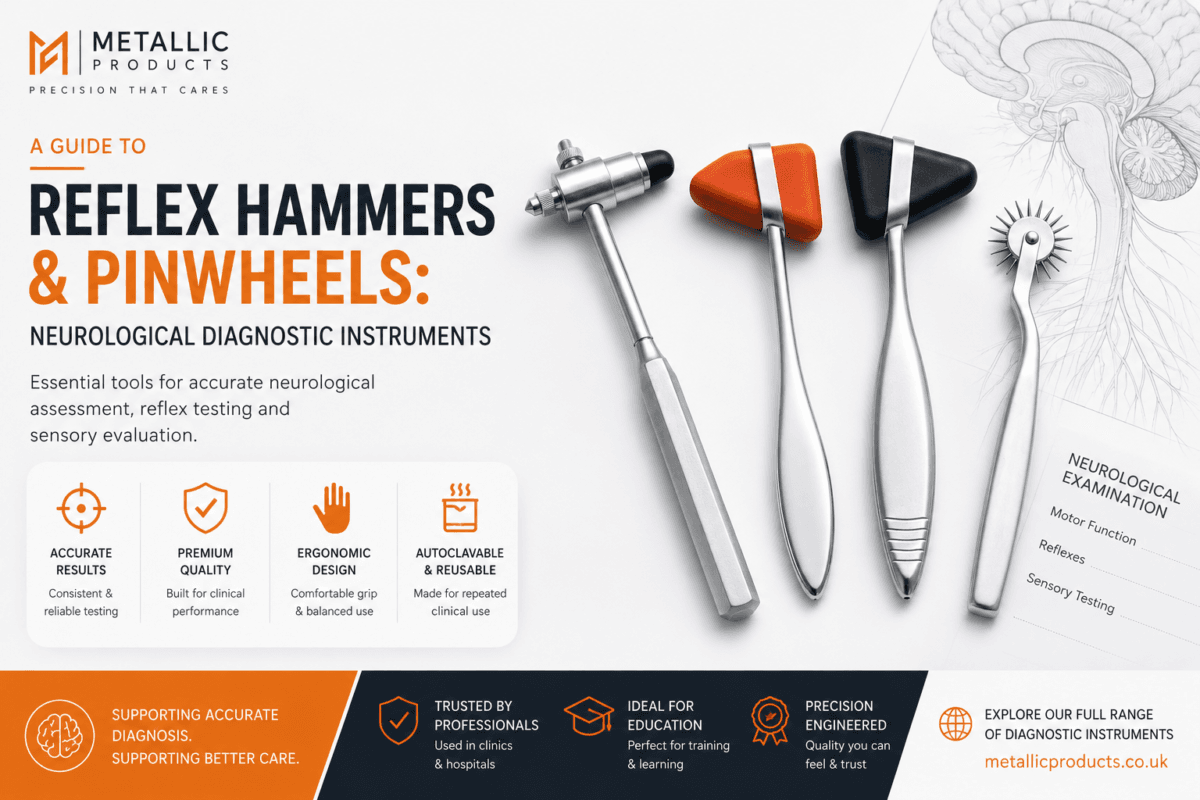
Reflex Hammers and Pinwheels: A Guide to Neurological Diagnostic Instruments
Reflex Hammers and Pinwheels: A Guide to Neurological Diagnostic Instruments
Definition
Reflex hammers are handheld diagnostic instruments used to test deep tendon reflexes and neurological function by delivering a controlled tap to a tendon. Alongside sensory pinwheels, they form the core toolkit clinicians use for neurological examinations, helping assess nerve function, motor coordination, and reflex response in both clinical and educational settings.
Introduction
Neurological examinations rely on a small set of precise, purpose-built instruments, and among the most essential are reflex hammers and sensory testing pinwheels. Whether assessing deep tendon reflexes, motor coordination, or nerve sensitivity, the right instrument supports accurate, repeatable results across every examination. This guide covers the main types of reflex hammers, how sensory pinwheels are used alongside them, and what to look for when choosing diagnostic instruments for clinical or educational use.
Why the Right Instrument Matters in Neurological Examination
Reflex and sensory testing require consistent, controlled contact to produce reliable results. A poorly weighted or badly designed hammer can produce inconsistent reflex responses, while a pinwheel with uneven pin spacing can give unreliable sensory readings.
Good quality instruments help clinicians:
- Achieve consistent, repeatable test results
- Support accurate neurological assessment
- Work confidently across a full patient examination
- Maintain reliable performance across repeated use
- Extend the working life of the instrument
As a result, choosing the right reflex hammer and pinwheel is an important part of both clinical practice and neurological training.
Types of Reflex Hammers
Different reflex hammers suit different examination styles and clinical preferences.
| Type | Design | Best suited for |
|---|---|---|
| Babinski/Buck Hammer | Wheel shaped head with a pin and brush attachment | General reflex testing, combined motor and sensory assessment |
| Babinsky Hammer | Triangular rubber head, weighted handle | Deep tendon reflex testing, neurological exams |
| Taylor Hammer | Triangular rubber head, lightweight handle | Widely used general purpose reflex testing, popular in training settings |
Babinski/Buck Reflex Hammer
The Babinski/Buck hammer combines a pin and a small brush attachment alongside the reflex head, allowing clinicians to test both reflex response and superficial sensation with a single instrument.
Babinsky Hammer
With a triangular rubber head and a weighted handle, the Babinsky hammer delivers consistent, controlled taps for deep tendon reflex testing, a standard choice in general neurological examination.
Taylor Hammer
Also known as the Tomahawk reflex hammer, the Taylor hammer is one of the most widely used reflex testing instruments. Its lightweight, triangular rubber head and balanced handle make it a popular choice for both clinical practice and medical training.
The Role of the Wartenberg Pin Wheel in Sensory Testing
While reflex hammers test tendon response, sensory testing requires a different instrument. The Wartenberg Pin Wheel uses a smooth rolling wheel with evenly spaced pins to assess nerve sensitivity and skin response, complementing reflex testing as part of a complete neurological examination.
Used together, a reflex hammer and a pinwheel allow clinicians to assess both motor reflex response and sensory nerve function in a single patient examination.
How to Choose the Right Reflex Hammer
When selecting a reflex hammer, consider the following:
Head Design
Triangular rubber heads suit general deep tendon reflex testing, while combination heads with pin and brush attachments support broader sensory and reflex assessment in one tool.
Handle Weight and Balance
A well balanced handle delivers consistent tap force without requiring excessive effort, supporting more reliable, repeatable results.
Material and Durability
Stainless steel handles paired with durable rubber heads hold up to repeated clinical and educational use without losing responsiveness.
Intended Setting
General practice and training environments often favour lightweight, versatile hammers like the Taylor hammer, while specialist neurological settings may prefer combination instruments like the Babinski/Buck hammer.
Checklist: Building a Neurological Examination Kit
- At least one general purpose reflex hammer (Taylor or Babinsky)
- A combination hammer with pin and brush attachment for broader testing (Babinski/Buck)
- A Wartenberg Pin Wheel for sensory nerve testing
- Confirm all instruments are autoclavable for repeated clinical use
- Store instruments in a dedicated case to protect rubber heads and pin points
Common Mistakes in Reflex and Sensory Testing
- Using excessive force when testing reflexes, which can produce inconsistent or exaggerated responses
- Applying uneven pressure with a pinwheel, leading to unreliable sensory readings
- Using a worn or damaged rubber head, which reduces tap consistency
- Skipping regular inspection of pin points on a Wartenberg wheel for wear or damage
Frequently Asked Questions
The Taylor hammer, also known as the Tomahawk hammer, is used for deep tendon reflex testing during neurological examinations, and is widely used in both clinical practice and medical training.
A Babinski/Buck hammer typically includes a pin and brush attachment for combined sensory and reflex testing, while a Taylor hammer has a simple triangular rubber head focused specifically on reflex testing.
It is used to assess nerve sensitivity and sensory response by rolling the wheel across the skin in a controlled manner, commonly used alongside reflex hammers in neurological examinations.
Yes, provided they are properly cleaned and disinfected between uses following standard clinical infection control procedures.
Handles are typically autoclavable if made from stainless steel, though rubber heads should be checked against manufacturer guidance, as repeated high heat sterilisation can affect rubber components over time.
Role of Metallic Products
Metallic Products manufactures precision-engineered diagnostic instruments designed to support accurate neurological examination.
Our range includes:
- Babinski/Buck, Babinsky, and Taylor reflex hammers
- The Wartenberg Pin Wheel for sensory nerve testing
- Durable stainless steel construction across our diagnostic range
- Instruments suited to both clinical practice and educational use
Conclusion
Understanding the different types of reflex hammers and how they work alongside sensory testing tools like the Wartenberg Pin Wheel helps clinicians and educators choose the right instruments for accurate, reliable neurological examination. Head design, handle balance, and material durability all contribute to consistent results across every assessment.
Explore our full range of neurological diagnostic instruments, or get in touch with our team for bulk or trade orders.