
Dental Instruments
Extraction Forceps Types: A Complete Guide for Dental Professionals
Extraction Forceps Types: A Complete Guide for Dental Professionals
Introduction
Understanding the different extraction forceps types is essential for safe, efficient, and predictable tooth extractions. Dental professionals use a wide range of extraction forceps because every tooth has unique anatomical features, including crown shape, root configuration, and position within the mouth. Choosing the correct forceps improves clinical control, reduces the risk of complications, and supports better treatment outcomes.
Whether you are purchasing new instruments or expanding your extraction kit, this guide explains the most common types of dental extraction forceps and their clinical applications.
Why Are There Different Types of Extraction Forceps?
No single extraction forceps can remove every tooth effectively.
Manufacturers design forceps to match the anatomy of specific teeth. As a result, dentists can achieve better grip, improved leverage, and greater control throughout the extraction procedure.
Selecting the correct forceps helps clinicians:
- Improve tooth engagement
- Reduce the risk of crown or root fracture
- Increase procedural efficiency
- Minimise unnecessary trauma
- Enhance patient comfort
Therefore, every dental practice should maintain a comprehensive range of extraction forceps.
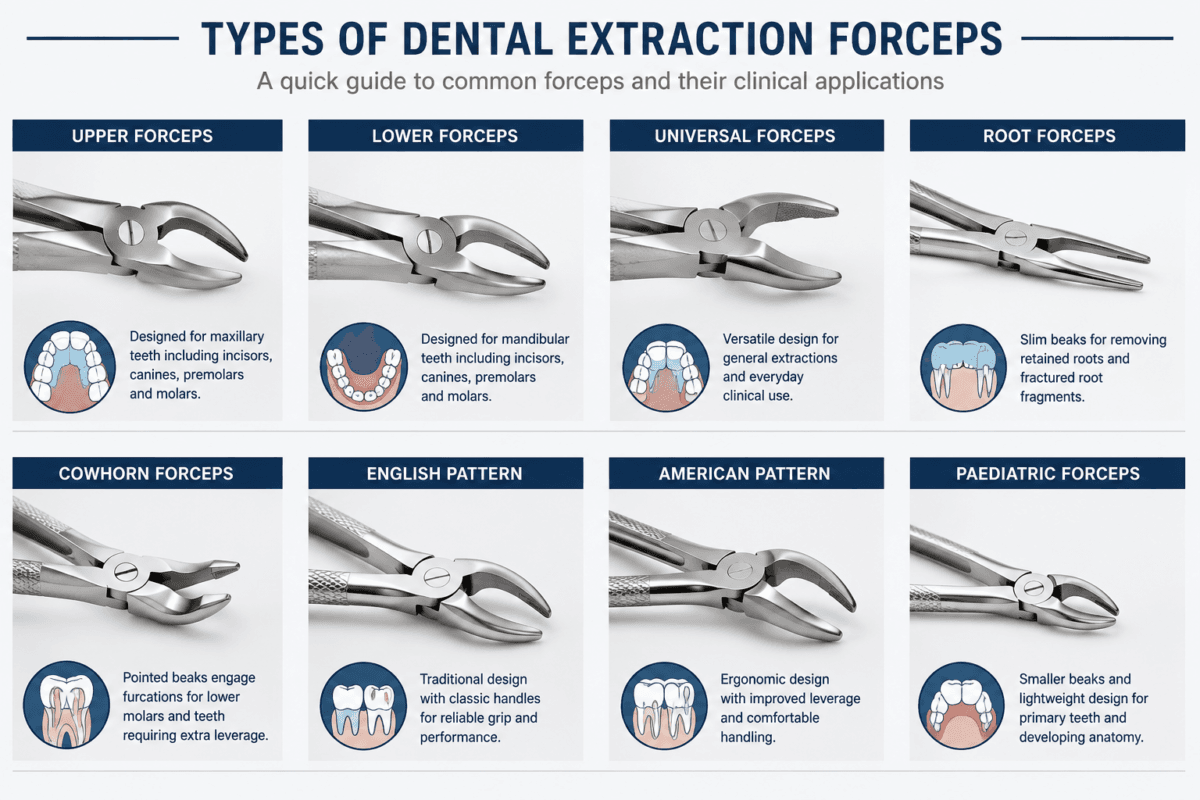
1. Upper Extraction Forceps
Upper extraction forceps are designed specifically for teeth in the maxillary arch.
They are commonly used for:
- Upper incisors
- Upper canines
- Upper premolars
- Upper molars
- Upper retained roots
Because upper teeth vary considerably in root anatomy, clinicians often require different forceps for different tooth groups.
2. Lower Extraction Forceps
Lower extraction forceps are designed for mandibular teeth.
Their shape and angulation provide improved access and leverage during lower tooth extractions.
Dentists commonly use them for:
- Lower incisors
- Lower canines
- Lower premolars
- Lower molars
- Root fragment removal
Consequently, these instruments play an essential role in routine and surgical extractions.
3. Universal Extraction Forceps
Universal extraction forceps allow clinicians to perform a variety of extractions using a versatile instrument.
Many practices keep universal forceps available for:
- General dentistry
- Routine extractions
- Everyday clinical procedures
Although universal forceps are convenient, dentists often achieve better results by selecting forceps designed for the specific tooth being removed.
4. Root Forceps
Root forceps help remove retained roots and fractured root fragments.
These instruments feature slimmer beaks that improve access to confined spaces.
Dentists often use root forceps when:
- The crown has fractured
- Root fragments remain
- Limited access makes standard forceps unsuitable
As a result, root forceps form an important part of every extraction kit.
5. Cowhorn Extraction Forceps
Cowhorn forceps have distinctive pointed beaks that engage the furcation of certain molars.
Dentists frequently select them when extracting:
- Lower molars with furcation access
- Teeth requiring additional leverage
Because of their specialised design, cowhorn forceps provide excellent grip during specific extraction procedures.
6. English Pattern Extraction Forceps
English pattern forceps have long been used in dental practices around the world.
They are recognised for:
- Traditional handle design
- Strong construction
- Comfortable grip
- Reliable clinical performance
Many clinicians continue to prefer English pattern instruments because of their familiar handling characteristics.
7. American Pattern Extraction Forceps
American pattern extraction forceps feature a different handle and hinge design compared with English patterns.
Their advantages often include:
- Improved ergonomics
- Enhanced leverage
- Comfortable handling
- Precise control
Ultimately, the choice between English and American patterns often depends on clinician preference.
8. Paediatric Extraction Forceps
Children require instruments designed for smaller teeth and developing anatomy.
Paediatric extraction forceps typically feature:
- Smaller working ends
- Lightweight construction
- Improved access
- Better handling for primary teeth
Using appropriately sized instruments helps clinicians perform paediatric extractions more safely and comfortably.
How to Choose the Right Extraction Forceps
Selecting the appropriate forceps depends on several important factors.
Tooth Position
Different teeth require different forceps designs.
Root Anatomy
Root shape influences both instrument selection and extraction technique.
Crown Condition
Damaged teeth may require specialised forceps.
Clinical Access
Posterior teeth often demand instruments designed for improved visibility and leverage.
Clinician Preference
Many experienced dentists develop preferences based on handling characteristics and clinical experience.
Therefore, practices should maintain a varied collection of extraction forceps.
What Makes High-Quality Extraction Forceps?
When purchasing extraction forceps, dental professionals should consider several important features.
Premium Stainless Steel
High-quality stainless steel improves durability and corrosion resistance.
Precision Beak Alignment
Accurate alignment provides secure tooth engagement and better clinical control.
Strong Box Joint Construction
A well-manufactured joint supports smooth operation and long-term reliability.
Ergonomic Handles
Comfortable handles improve grip and reduce hand fatigue during lengthy procedures.
Sterilisation Compatibility
Quality forceps should withstand repeated autoclave cycles while maintaining performance.
Common Mistakes When Selecting Extraction Forceps
Clinicians should avoid several common purchasing and selection mistakes.
These include:
- Using one forceps type for every extraction
- Ignoring tooth anatomy
- Choosing instruments based only on price
- Purchasing poor-quality instruments
- Failing to replace worn forceps
Avoiding these mistakes helps improve extraction efficiency and long-term instrument performance.
Why Every Dental Practice Needs a Complete Forceps Collection
A comprehensive extraction kit allows clinicians to manage a wide variety of cases confidently.
A well-equipped practice should include:
- Upper extraction forceps
- Lower extraction forceps
- Universal forceps
- Root forceps
- Cowhorn forceps
- English pattern forceps
- American pattern forceps
- Paediatric forceps
Maintaining a complete selection improves flexibility and supports better clinical outcomes.
Why Choose Metallic Products?
Metallic Products manufactures precision-engineered dental extraction forceps designed to meet the needs of modern dental professionals.
Our extraction forceps offer:
- Premium stainless steel construction
- Precision-aligned beaks
- Durable box joint mechanisms
- Ergonomic designs
- Reliable long-term performance
Our comprehensive range includes forceps for routine, surgical, and paediatric dental procedures, helping clinicians perform extractions with confidence and precision.
Conclusion
Understanding the different extraction forceps types helps dental professionals choose the right instrument for every procedure. From upper and lower forceps to root, universal, cowhorn, English pattern, American pattern, and paediatric designs, each instrument serves a specific clinical purpose.
By investing in high-quality extraction forceps and maintaining a complete extraction kit, dental practices can improve efficiency, support better treatment outcomes, and deliver high standards of patient care.