
Uncategorized
When Should Dental Scalers Be Sharpened or Replaced? Signs Every Clinician Should Know
When Should Dental Scalers Be Sharpened or Replaced? Signs Every Clinician Should Know
Introduction
Knowing when dental scalers should be sharpened or replaced is essential for maintaining clinical efficiency, patient comfort, and treatment quality. Sharp and well-maintained scalers allow dentists, dental hygienists, and dental therapists to remove deposits effectively while reducing unnecessary effort. However, like all hand instruments, scalers gradually wear over time. Understanding the warning signs of dullness and instrument wear can help clinicians maintain optimal performance and make informed replacement decisions.
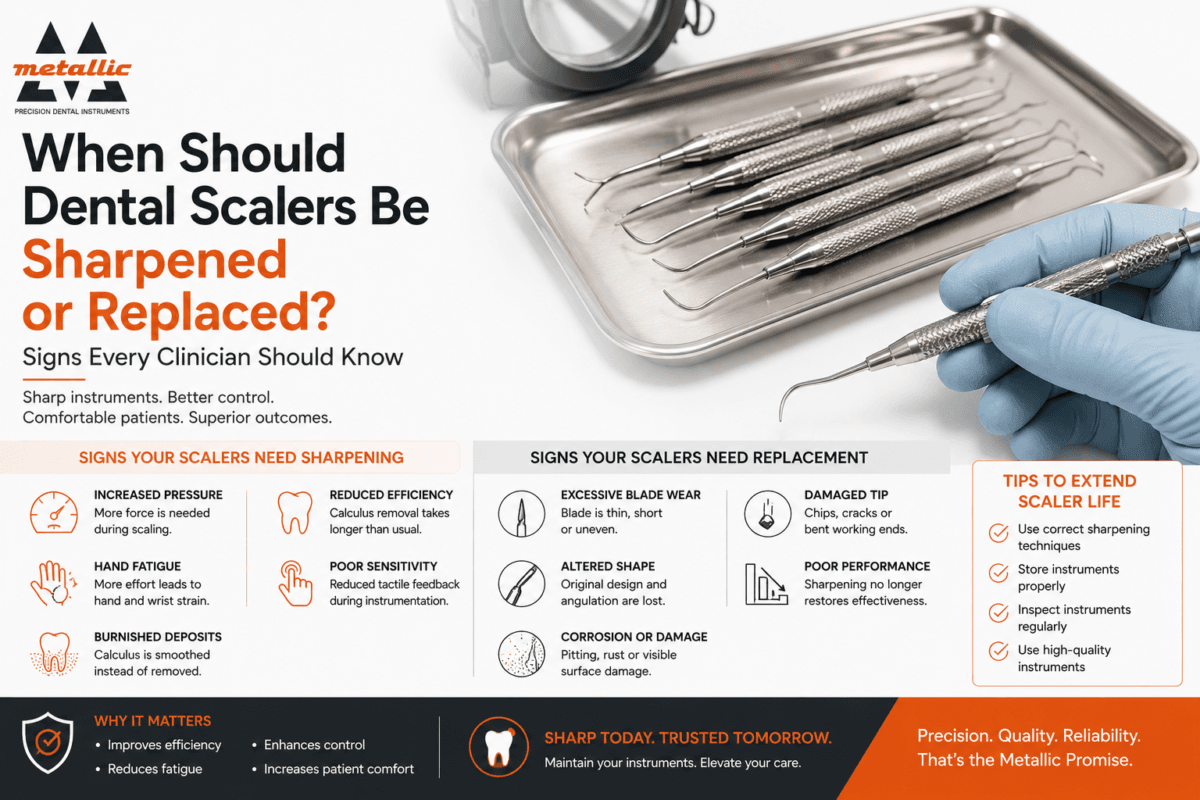
Why Scaler Sharpness Matters
Dental scalers play a critical role in preventive and periodontal care. Clinicians rely on sharp working edges to remove calculus and plaque efficiently.
Sharp scalers help:
- Improve scaling efficiency
- Enhance tactile sensitivity
- Reduce hand fatigue
- Increase clinician control
- Improve patient comfort
In contrast, dull instruments often require more pressure and additional strokes to achieve the same result.
What Causes Dental Scalers to Become Dull?
Several factors contribute to scaler wear over time.
Common causes include:
Repeated Clinical Use
Every scaling procedure creates gradual wear on the cutting edge. As a result, the instrument becomes less effective.
Frequent Sharpening
Although sharpening restores performance, repeated sharpening eventually removes metal from the working end.
Contact with Hard Deposits
Heavy calculus deposits can accelerate edge wear and reduce sharpness.
Improper Instrument Care
Incorrect cleaning, handling, or storage may damage the working edge and shorten instrument life.
Therefore, proper maintenance is essential for preserving instrument performance.
Signs Your Dental Scalers Need Sharpening
Many clinicians continue using dull scalers without realising how much performance has declined.
Look for these common signs:
Increased Pressure During Scaling
If you find yourself applying more force than usual, the cutting edge may have become dull.
Reduced Calculus Removal Efficiency
Sharp instruments remove deposits quickly and predictably. If scaling becomes more difficult, sharpening may be necessary.
Hand and Wrist Fatigue
Dull scalers often require additional effort. Consequently, clinicians may experience greater hand fatigue during procedures.
Poor Tactile Sensitivity
A sharp scaler provides clear feedback during treatment. In contrast, a worn edge can reduce sensitivity and control.
Burnished Calculus Deposits
Instead of removing deposits, dull instruments may smooth or burnish them. This makes complete removal more difficult.
How Often Should Dental Scalers Be Sharpened?
There is no single schedule that works for every practice.
The frequency depends on:
- Clinical workload
- Type of procedures performed
- Instrument quality
- Sharpening technique
- Calculus severity
Many clinicians inspect their scalers regularly and sharpen them whenever performance begins to decline.
Therefore, routine evaluation is more important than following a fixed timeline.
Signs Your Dental Scalers Should Be Replaced
Sharpening can restore performance for a long time. However, every scaler eventually reaches the end of its service life.
Excessive Blade Wear
Repeated sharpening gradually reduces blade size.
When the working end becomes too thin or narrow, replacement is usually the best option.
Altered Instrument Shape
A scaler should maintain its original design and geometry.
If sharpening significantly changes the shape, clinical effectiveness may decrease.
Damaged Working Ends
Chipped, bent, or damaged tips can affect performance and compromise patient safety.
Corrosion or Surface Damage
Although high-quality stainless steel resists corrosion, damaged instruments should be replaced promptly.
Reduced Clinical Performance
If a scaler no longer performs effectively despite proper sharpening, replacement may be necessary.
Sharpening vs Replacing: How to Decide
Clinicians often wonder whether sharpening or replacement is the better option.
Sharpen the Instrument When:
- The blade remains structurally sound
- The original shape is preserved
- Performance improves after sharpening
- No damage is present
Replace the Instrument When:
- Significant metal loss has occurred
- The working end has become distorted
- Visible damage is present
- Sharpening no longer restores performance
As a result, regular inspection helps clinicians make informed decisions.
How Dull Scalers Affect Patient Care
Instrument condition directly influences treatment quality.
Dull scalers may:
- Increase treatment time
- Require more strokes
- Reduce efficiency
- Increase clinician fatigue
- Affect patient comfort
In contrast, sharp instruments help clinicians deliver more effective and comfortable care.
Tips for Extending the Life of Dental Scalers
Proper maintenance can significantly increase instrument lifespan.
Follow Correct Sharpening Techniques
Proper sharpening helps preserve blade geometry and performance.
Store Instruments Carefully
Protect working ends from unnecessary contact and damage.
Inspect Instruments Regularly
Routine inspections help identify wear before performance declines.
Use High-Quality Instruments
Premium instruments often maintain their edges longer and provide better long-term value.
Therefore, investing in quality instruments can reduce replacement frequency.
What Makes a High-Quality Dental Scaler?
When purchasing replacement scalers, dental professionals should consider:
Material Quality
High-grade stainless steel improves durability and corrosion resistance.
Edge Retention
Quality instruments maintain sharpness longer between sharpening sessions.
Precision Manufacturing
Consistent blade geometry supports predictable clinical performance.
Ergonomic Handle Design
Comfortable handles reduce hand fatigue and improve control.
Sterilisation Resistance
Instruments should withstand repeated autoclave cycles without compromising performance.
Role of Metallic Products
Metallic Products manufactures precision-engineered dental scalers designed for modern clinical requirements.
Features include:
- Premium stainless steel construction
- Precision-crafted working ends
- Excellent edge retention
- Ergonomic handle options
- Reliable long-term performance
These features help dental professionals maintain efficiency and confidence during scaling procedures.
Conclusion
Understanding when dental scalers should be sharpened or replaced is essential for maintaining clinical performance and patient comfort. While sharpening can restore cutting efficiency, every scaler eventually reaches a point where replacement becomes the better option.
By inspecting instruments regularly, following proper maintenance practices, and investing in high-quality scalers, dental professionals can improve treatment efficiency, reduce fatigue, and deliver better patient care.