
Dental Instruments
Gracey Curettes vs Universal Curettes: Which Should Your Practice Choose?
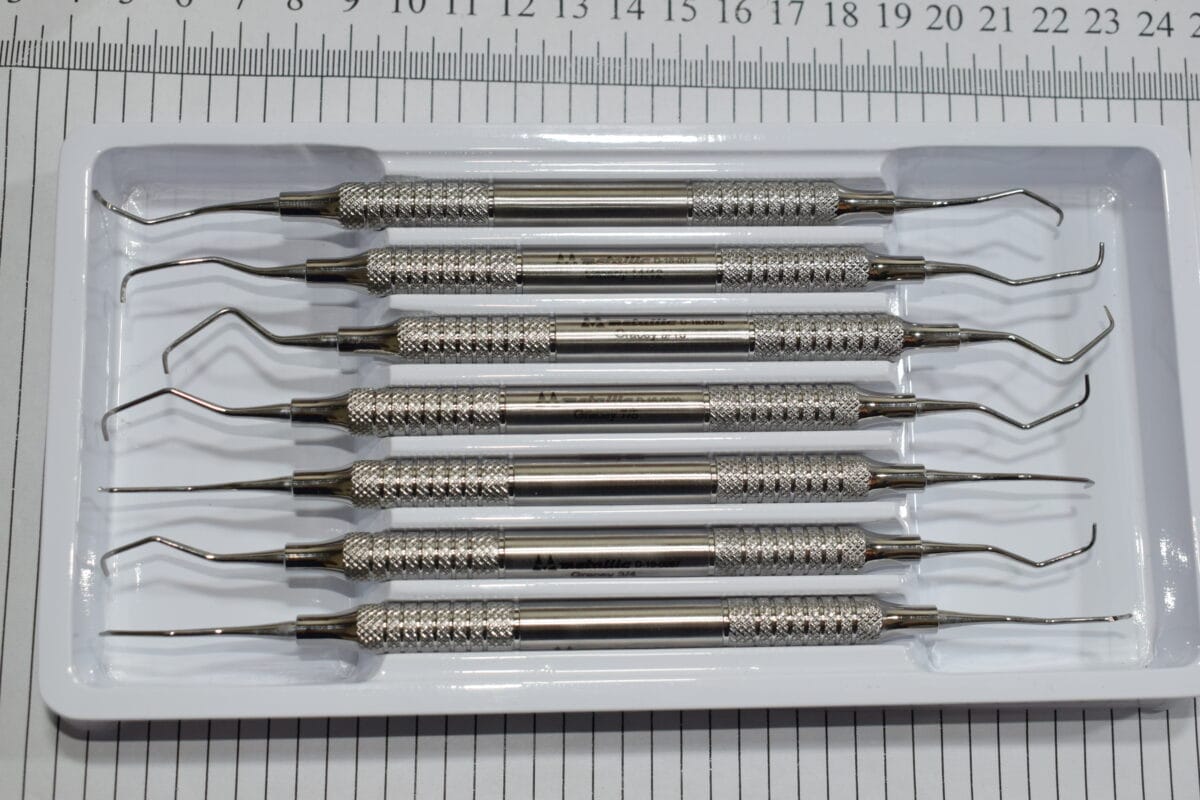
Jun
Gracey Curettes vs Universal Curettes: Which Should Your Practice Choose?
Introduction
Selecting the right periodontal instruments is essential for effective scaling and root surface debridement. One of the most common questions asked by dentists, dental hygienists, dental therapists, and periodontal professionals is: Gracey curettes vs universal curettes—which should your practice choose?
Both instrument types are widely used in periodontal care, yet they are designed for different clinical applications. Understanding the differences between Gracey curettes and universal curettes can help dental professionals make informed purchasing decisions and ensure they have the right instruments for their treatment needs.
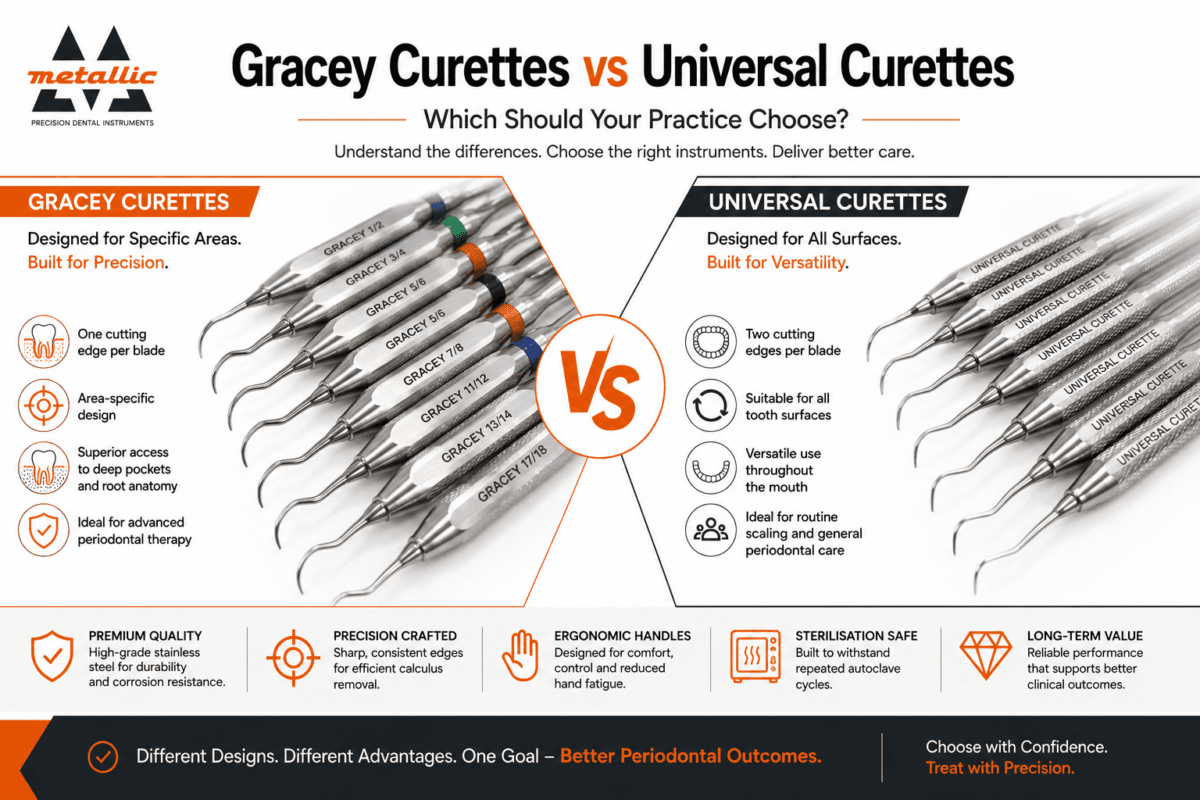
What Is a Periodontal Curette?
A periodontal curette is a hand instrument used to remove subgingival calculus, biofilm, and diseased tissue from root surfaces during periodontal treatment.
High-quality curettes help clinicians:
- Improve scaling efficiency
- Enhance access to periodontal pockets
- Increase treatment precision
- Support patient comfort
- Improve clinical outcomes
As a result, curettes remain essential instruments in modern dental hygiene and periodontal therapy.
What Are Universal Curettes?
Universal curettes are designed to be used throughout the entire mouth.
Their working ends are engineered so clinicians can adapt the same instrument to multiple tooth surfaces.
Key Features of Universal Curettes
- Two cutting edges per working end
- Suitable for all tooth surfaces
- Versatile clinical application
- Reduced number of instruments required
Consequently, universal curettes are often considered practical instruments for general periodontal procedures.
What Are Gracey Curettes?
Gracey curettes are area-specific instruments designed to adapt to particular tooth surfaces and anatomical regions.
Each Gracey curette is intended for specific areas of the mouth, allowing clinicians to achieve optimal adaptation during treatment.
Key Features of Gracey Curettes
- One cutting edge per working end
- Area-specific design
- Enhanced adaptation to root surfaces
- Improved access to deep periodontal pockets
Therefore, Gracey curettes are commonly preferred for advanced periodontal therapy.
Gracey Curette Types and Numbering
Gracey curettes are classified by number, with each pair designed for a specific tooth surface and area of the mouth. The 1/2 and 3/4 pairs, for instance, are used on anterior teeth, while 5/6 extends coverage to anterior teeth and premolars.
Moving further back in the mouth, 7/8 and 9/10 are designed for posterior teeth, addressing facial and lingual surfaces. Similarly, 11/12 targets posterior mesial surfaces, whereas 13/14 is built specifically for posterior distal surfaces.
Finally, 15/16 and 17/18 offer modified designs that improve access to posterior areas that standard curettes struggle to reach. Selecting the correct number therefore ensures optimal blade adaptation to the tooth surface being treated, improving both efficiency and patient comfort.
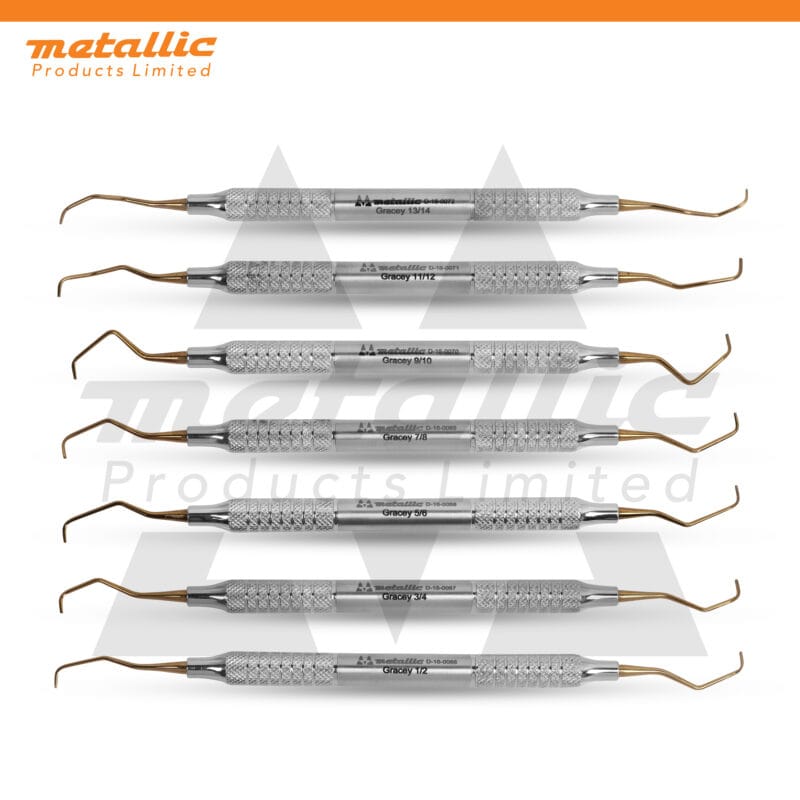
Gracey Curettes vs Universal Curettes: Key Differences
1. Instrument Design
Universal Curettes
Universal curettes feature a blade positioned at approximately 90 degrees to the terminal shank.
This design allows both cutting edges to be used during treatment.
Gracey Curettes
Gracey curettes feature a blade offset at approximately 70 degrees to the terminal shank.
As a result, only one cutting edge is used during instrumentation.
2. Clinical Versatility
Universal Curettes
Advantages include:
- Suitable for all tooth surfaces
- Fewer instruments required
- Simplified instrument selection
Therefore, they are often used during routine periodontal procedures.
Gracey Curettes
Advantages include:
- Area-specific adaptation
- Improved access in complex anatomy
- Enhanced precision
Consequently, they are particularly useful in specialised periodontal treatment.
3. Access to Deep Periodontal Pockets
Access is critical when treating periodontal disease.
Universal Curettes
Can be effective in moderate periodontal pockets but may offer less adaptation in complex root anatomy.
Gracey Curettes
Designed specifically for:
- Deep periodontal pockets
- Furcation areas
- Root concavities
- Difficult-to-access surfaces
As a result, many periodontal professionals prefer Gracey curettes for advanced cases.
4. Precision and Adaptation
Universal Curettes
Provide versatility and efficiency for general use.
Gracey Curettes
Offer superior adaptation to specific tooth surfaces.
Benefits include:
- Improved root surface contact
- Better tactile sensitivity
- Greater treatment precision
Therefore, Gracey curettes are often chosen when precise instrumentation is required.
5. Learning Curve
Universal Curettes
Because they can be used throughout the mouth, universal curettes are generally easier for new clinicians to learn.
Gracey Curettes
Area-specific designs require clinicians to understand instrument selection and adaptation techniques.
Consequently, mastering Gracey curettes may require additional training and experience.
Which Curette Is Better for Dental Hygienists?
The answer depends on clinical requirements.
Many dental hygienists use:
- Universal curettes for routine scaling procedures
- Gracey curettes for periodontal maintenance and advanced root debridement
Therefore, both instrument types often play an important role in daily practice.
Which Curette Is Better for Periodontal Therapy?
For advanced periodontal treatment, many clinicians prefer Gracey curettes because they provide:
- Better access
- Improved adaptation
- Greater precision
- Enhanced root surface instrumentation
As a result, Gracey curettes are widely used in periodontal practices.
Should Your Practice Have Both?
Many successful dental practices maintain both universal and Gracey curettes.
Benefits include:
- Greater clinical flexibility
- Improved treatment efficiency
- Better instrument selection for different procedures
- Enhanced patient care
Consequently, a combination of both instrument types often provides the most comprehensive solution.
What Makes a High-Quality Curette?
When purchasing periodontal instruments, dental professionals should consider:
Material Quality
Gracey curettes and scalers are available in both plastic handle and full stainless steel construction. Plastic handle versions are lightweight and cost-effective, suited to routine general use. Stainless steel versions are heavier, more durable, and better suited to repeated sterilisation and daily professional or clinical use. Practices with high patient volume typically prefer stainless steel for its longevity through repeated autoclave cycles.
Edge Retention
Sharp cutting edges contribute to efficient calculus removal.
Precision Manufacturing
Consistent blade geometry improves clinical performance.
Ergonomic Handle Design
Comfortable handles help reduce hand fatigue during prolonged procedures.
Sterilisation Resistance
Professional instruments should withstand repeated autoclave cycles without compromising performance.
Buying Considerations for Dental Practices
Before purchasing curettes, practices should evaluate:
- Clinical services offered
- Frequency of periodontal procedures
- Instrument durability
- Manufacturer reputation
- Long-term value
Because of these factors, selecting high-quality curettes can improve both treatment outcomes and operational efficiency.
Frequently Asked Questions
A universal curette has two cutting edges and a 90 degree blade angle, usable on any tooth surface. A Gracey curette has one cutting edge and a 70 degree offset blade, designed for specific tooth areas.
Gracey curettes are used for area-specific periodontal work, particularly deep pockets, furcations, and root concavities requiring precise adaptation.
Yes, both plastic handle and stainless steel versions are available, with stainless steel better suited to high-volume, repeated sterilisation use.
Role of Metallic Products
Metallic Products manufactures precision-engineered periodontal instruments designed to support modern dental practice requirements.
Features include:
- Premium stainless steel construction
- Precision-crafted working ends
- Ergonomic handle options
- Reliable long-term performance
- Sterilisation-compatible designs
This helps dental professionals perform periodontal procedures with confidence and consistency.
Conclusion
When comparing Gracey curettes vs universal curettes, neither instrument is universally better. Universal curettes provide versatility and convenience, while Gracey curettes offer superior adaptation and precision in specific clinical situations.
For many dental practices, maintaining both instrument types provides the flexibility needed to manage a wide range of periodontal procedures effectively. By investing in high-quality curettes, clinicians can improve treatment efficiency, support patient comfort, and achieve better clinical outcomes.